The Week that Was
The first full month of the year is behind us, and, honestly, it has been rather more dramatic than most had anticipated when toasting the New Year.
We wrapped up last week with US President Donald Trump announcing his Fed Chair pick. Via his Truth Social platform, the President selected Kevin Warsh – though the Senate will still need to confirm the pick – sending precious metals into a tailspin.
However, the question for many market participants is what we will see from Warsh, with a number of desks noting uncertainty behind ‘which Kevin we will get’. For years, Warsh has had a track record of being an ‘inflation hawk’, one that is cautious about lowering rates. However, in the lead-up to the Fed Chair nomination, we have seen him arguing for shrinking the balance sheet – reducing money supply by allowing maturing securities to roll off – and lowering rates. As of writing, nevertheless, we have not really seen much change in rates pricing. The OIS curve still suggests two rate cuts this year (-55 bps).
The Fed Chair announcement triggered one of the most dramatic sell-offs in precious metals history, as the move eased Fed independence concerns. This sent Spot Silver down a whopping 27% and Spot Gold lost 9.0%. The downside move unravelled what has been a remarkable ascent, which saw Silver rally nearly 150% last year alone! As of writing, both metals have extended losses overnight in Asia, with Gold down 8.0%. In the FX space, the USD also ended Friday higher by around 1.0% but has offered little movement so far this morning.

The Week That Is
We have several updates from central banks this week, including the RBA, the BoE, and the ECB, as well as a few important economic indicators landing.
RBA eyeing a 25-bp hike
It is widely believed that the RBA will increase the cash rate by 25 bps on Tuesday at 3:30 am GMT to 3.85% from 3.60% – markets are assigning a 77% probability of a hike. This follows the central bank leaving the rate unchanged for three consecutive meetings at the tail end of last year.
Following commentary from RBA Governor Michelle Bullock – who directed focus to the possibility of rate hikes if inflationary pressures persist – coupled with strong jobs data and inflation coming in above the upper bound of the RBA’s 2-3% target range, markets are looking to a rate hike this week.
Should the RBA push forward and hike rates, I feel this will underpin a modest bid in the AUD, though it could prove short-lived. However, the question is what comes next; communication from the central bank will be important to monitor, so keep an eye on any shift in language that supports further tightening, which may add fuel to AUD upside. Some desks reported this could be a one-and-done hike, which might be seen as negative AUD; others forecast additional tightening may be warranted if upside pressures do not subside. The upcoming meeting will also include the Statement of Monetary Policy and is expected to reveal upward revisions in growth and inflation.
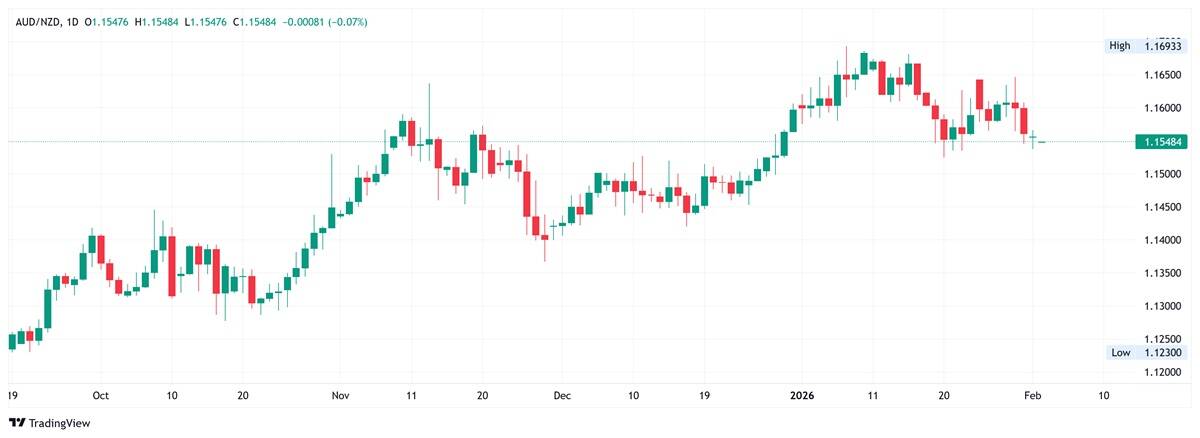
The AUD/NZD cross may be one to watch – a pure play given the policy divergence between the RBA and the RBNZ. Although the latter has witnessed a hawkish shift of late, the AUD/NZD remains a market of interest, as the RBA is actively hiking rates, while the RBNZ is merely transitioning from easing to holding – markets are not pricing in much for the RBNZ until September this year.
BoE and ECB Set to Keep Rates Unchanged
Both the BoE and the ECB are set to remain on hold this week, scheduled to make the airwaves on Thursday at 12:00 pm and 1:15 pm, respectively.
For the BoE, the MPC are widely expected to keep the bank rate unchanged at 3.75%; this follows the central bank lowering the rate by 25 bps from 4.00% in December in a narrow 5-4 vote split. Why are markets expecting the central bank to keep things steady this week? You will likely recall that in December, BoE Governor Andrew Bailey said that he is open to easing policy if there is evidence of inflation moving towards their 2.0% target. The December CPI inflation data showed that price pressures accelerated to 3.4% from 3.2% in November. This is not the proof he is looking for, clearly.
Also, take into account that on one side of the fence, we have four MPC hawks – focussing on sticky price pressures – and on the other side, we have four MPC doves concerned about the labour market, with Bailey seen as the swing voter. Therefore, current voting dynamics continue to suggest a divided house.
From my perspective, although the central bank is in ‘wait-and-see’ mode, given softening jobs data, this should eventually lead to disinflation, thereby allowing the BoE to cut rates. However, timing remains data-dependent for when the BoE next moves, especially as it is also edging closer to a neutral rate. Markets are fully pricing in a June 25-bp cut, with a total of 37 bps of easing priced in – that is, less than two cuts currently.
Given markets widely expect a hold decision, any upside in the GBP could prove fleeting on the decision itself as it has largely been priced in. Traders will closely watch the MPC vote split. A hawkish hold, which suggests more MPC members have chosen to keep rates higher, could aid a GBP bid, while a dovish hold – something in the region of a 5-4 vote – implies a rate cut could come sooner than markets are expecting and weigh on the GBP.
For the ECB, with inflation near target, resilient economic growth, and the central bank viewing policy as in a ‘good place’, markets are pricing in that the central bank will keep its three benchmark rates on hold, leaving the deposit facility rate at 2.00% and the refinancing rate at 2.15%.
January US Jobs Data Eyed
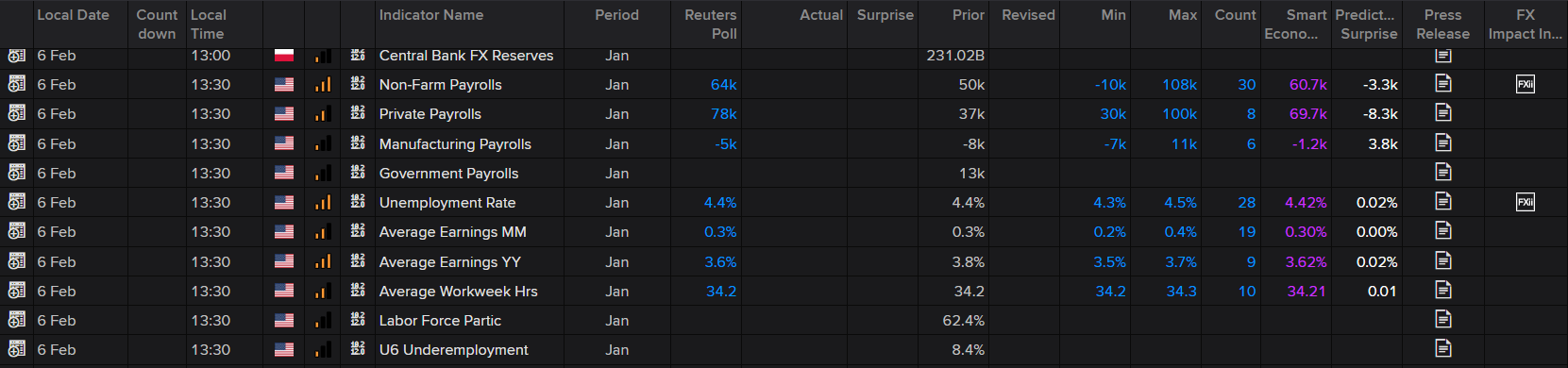
The week culminates with the January NFP event on Friday at 1:30 pm. As shown in the LSEG calendar below, following December’s 50,000 gain, the median estimate for January is 64,000, with a forecast range between 108,000 and -10,000. Unemployment is forecast to remain at 4.4%, though the range is between 4.5% and 4.3%.
A strong print this week – one that exceeds 85,000 payrolls – would help validate a patient Fed and likely bolster a USD bid. This would be emphasised if unemployment ticks lower to 4.3%. Conversely, for a negative report, I would be looking for payrolls to come in at or very close to 30,000 or below, with unemployment jumping to 4.5%, which could add to dovish rate-cut bets and prompt meaningful USD downside.
From a positioning perspective, I would favour a softer print based on where things are currently. In short, with the new Fed Chair taking the helm in May, and markets positioned for Fed patience right now, a weak NFP print would create the most surprise that forces a dovish repricing, while a robust report would simply validate current market positioning.
In addition to Friday’s NFP report, it is worth monitoring the February US ISM manufacturing PMI data today and the ISM services release on Wednesday, alongside the December US JOLTS job openings on Tuesday, and US weekly jobless claims on Thursday.
Written by FP Markets Chief Market Analyst Aaron Hill