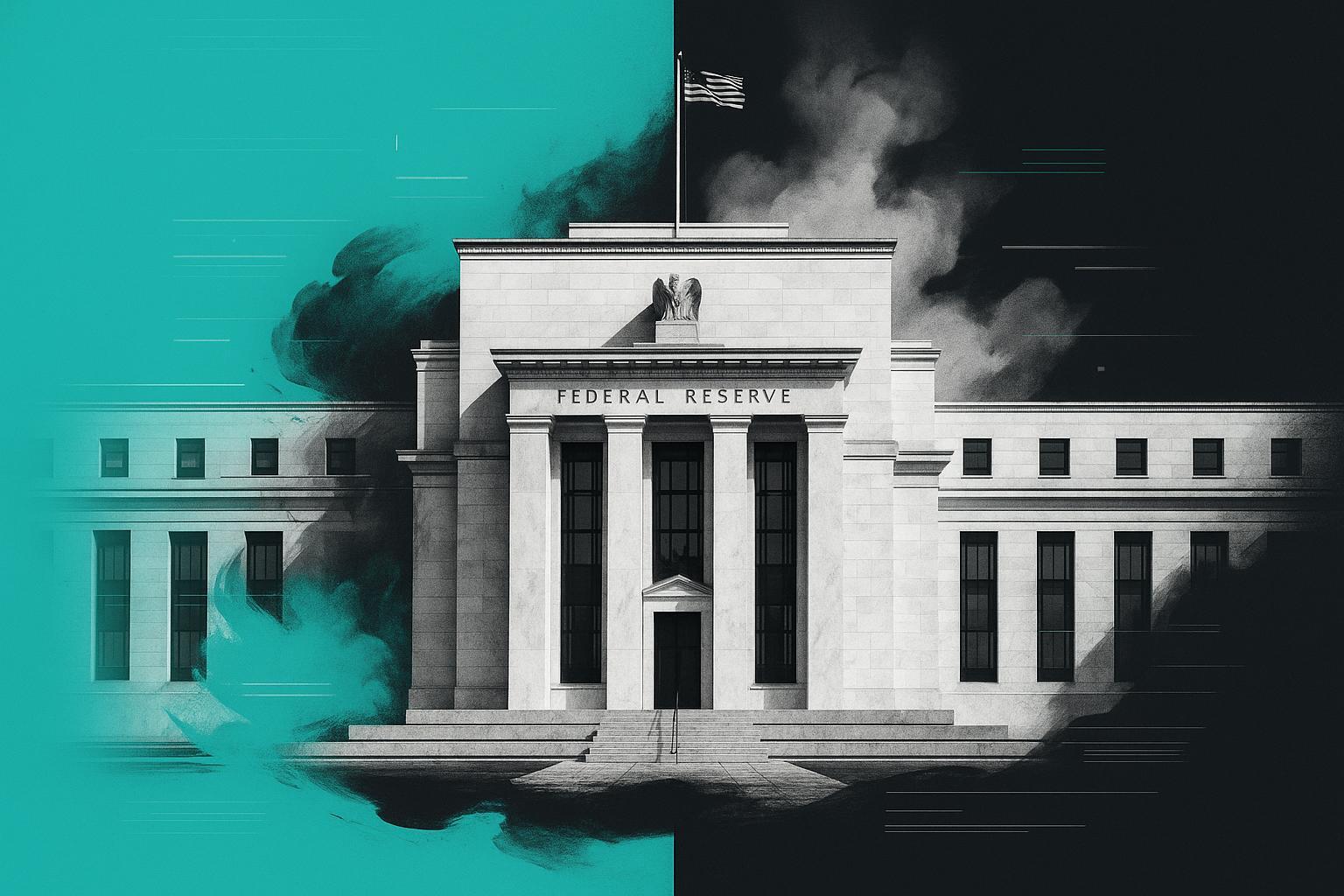
US stock futures faced another day of selling pressure early in the Asian market session on Monday, February 2. Ongoing concerns over the Fed’s monetary policy weighed on sentiment. Meanwhile, AI-related spending and return on investment remained a headwind for tech stocks.
Amid Fed policy uncertainty and concerns about AI investments, the Bank of Japan released its Summary of Opinions from January’s monetary policy meeting.
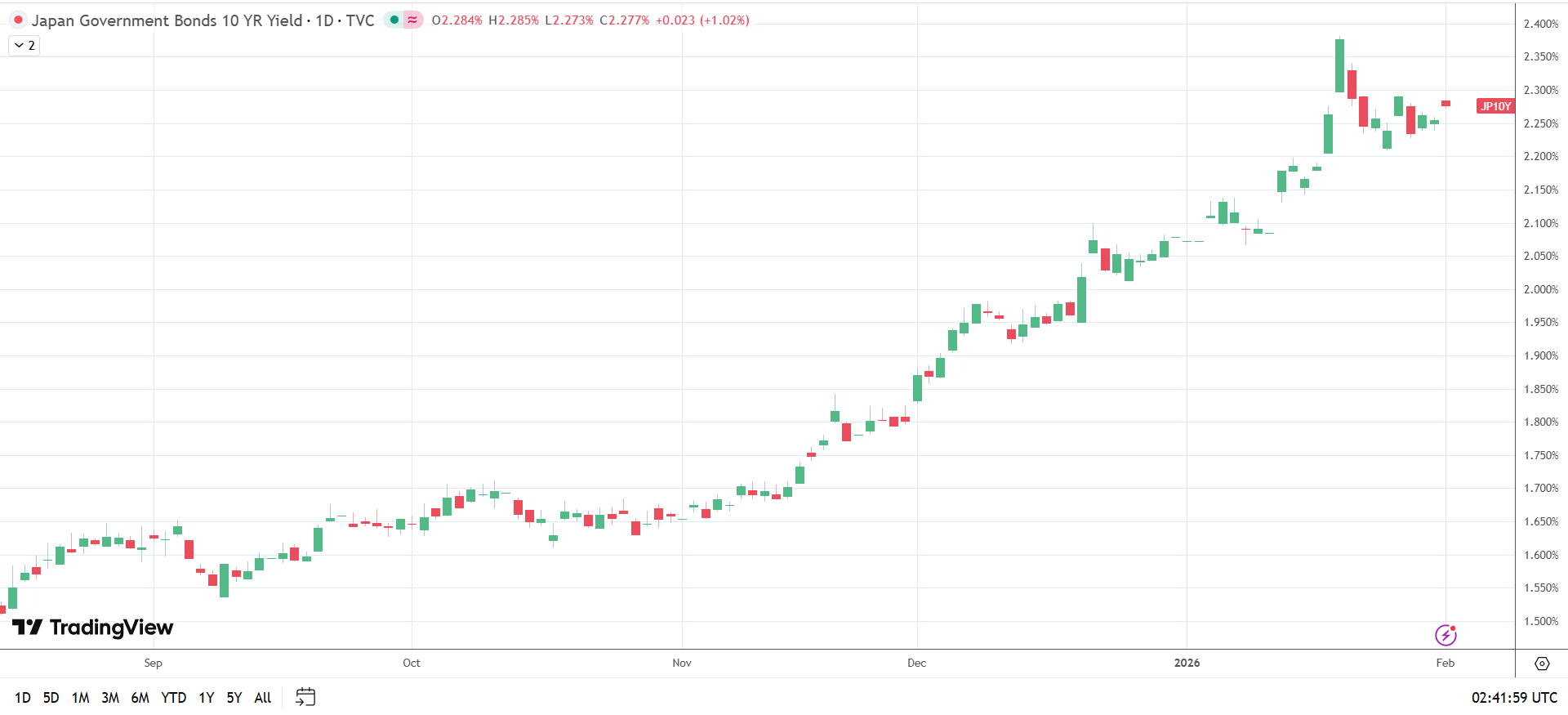
The Summary of Opinions had a hawkish spin, with policymakers supporting further rate hikes. 10-year Japanese Government Bond (JGB) yields advanced, weighing on risk assets. While the Nikkei 225 was flat, the Hang Seng Index fell 1.65% in early trading, tracking US equity futures.
Despite the morning pullback, expectations of multiple Fed rate cuts in 2026 and optimism over US corporate earnings support a cautiously bullish outlook for the US index futures.
Below, I’ll outline the key market drivers, the medium-term outlook, and the technical levels traders should watch.

Bank of Japan Summary of Opinions Reveals Support for Rate Hikes
The Bank of Japan’s Summary of Opinions showed growing support for further rate hikes, signaling a narrower US-Japan rate differential. Rising 10-year JGB yields and narrowing rate differentials dry up liquidity and increase the risk of a yen carry trade unwind, as seen in mid-2024.
The Kobeissi Letter recently highlighted the significance of Japanese investors, stating:
“Japanese holdings of US bonds and stocks totaled $2.22 trillion at the end of 2024, according to Bank of Japan data. This is followed by investments in the Cayman Islands, France, and the UK at $834 billion, $179 billion, and $150 billion, respectively.”
Notably, the Kobeissi Letter questioned the potential impact of investors repaying yen loans or investing into yen assets, adding”
“Japanese exposure to the US is TWICE as large as their combined position in these 3 countries. Furthermore, total foreign assets owned by Japanese investors rose to $4.95 trillion in Q3 2025, near an all-time high. This comes as they held $2.54 trillion in equity and investment-fund shares and $2.41 trillion in debt. What happens if these investors start bringing money back home?”
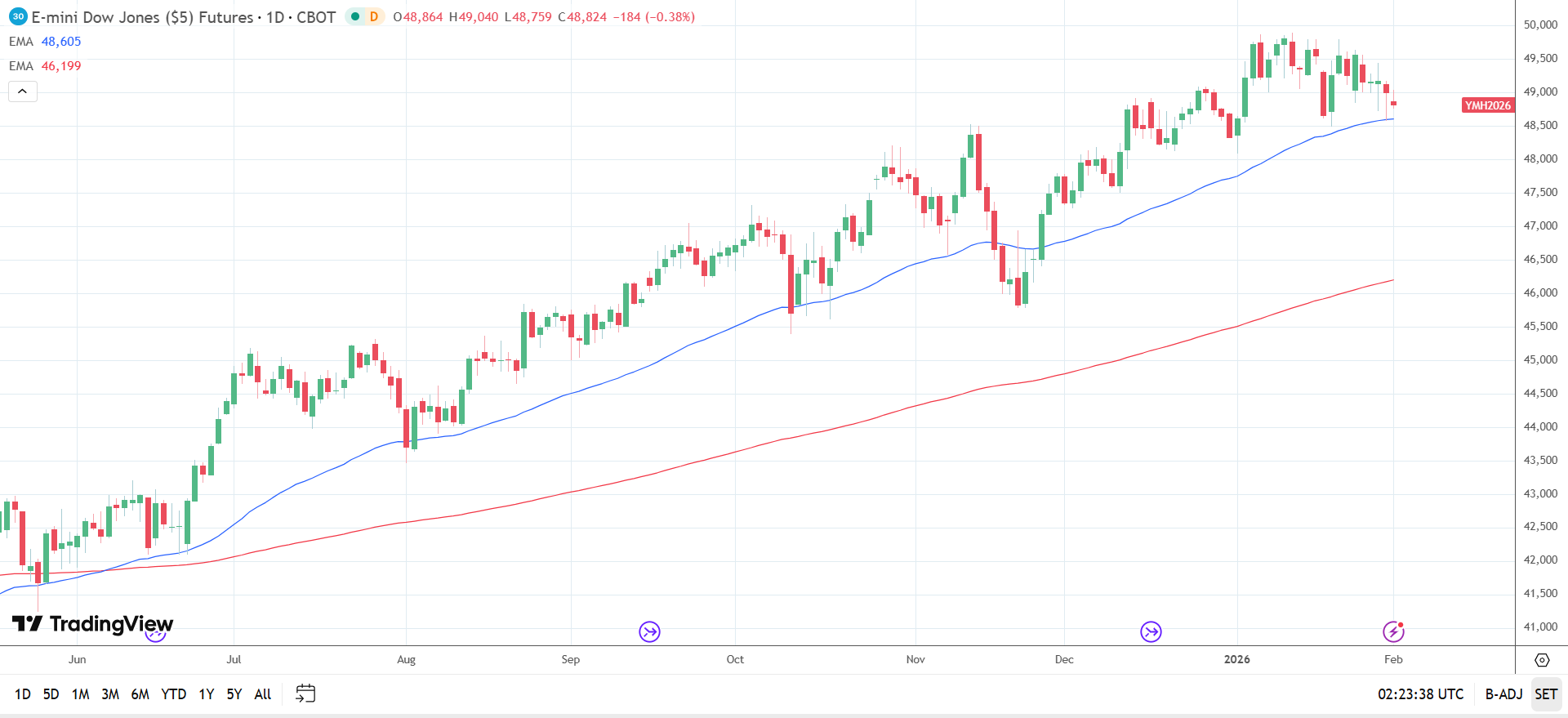
Rising JGB yields and a stronger yen against the US dollar would trigger a yen carry trade unwind. For context, the BoJ raised interest rates and cut Japanese Government Bond (JGB) purchases in July 2024, leading to an unwind in yen carry trades. The Nasdaq 100 tumbled 11.7% during a three-day sell-off. USD/JPY plunged from 153.889 to 141.684 over the same period, underscoring sensitivity to the BoJ’s policy stance.
Dow Jones Price Forecast
Every new Dow Jones analysis as it publishes, today's technical signal and key levels, live price — on one page.
See all Dow Jones forecasts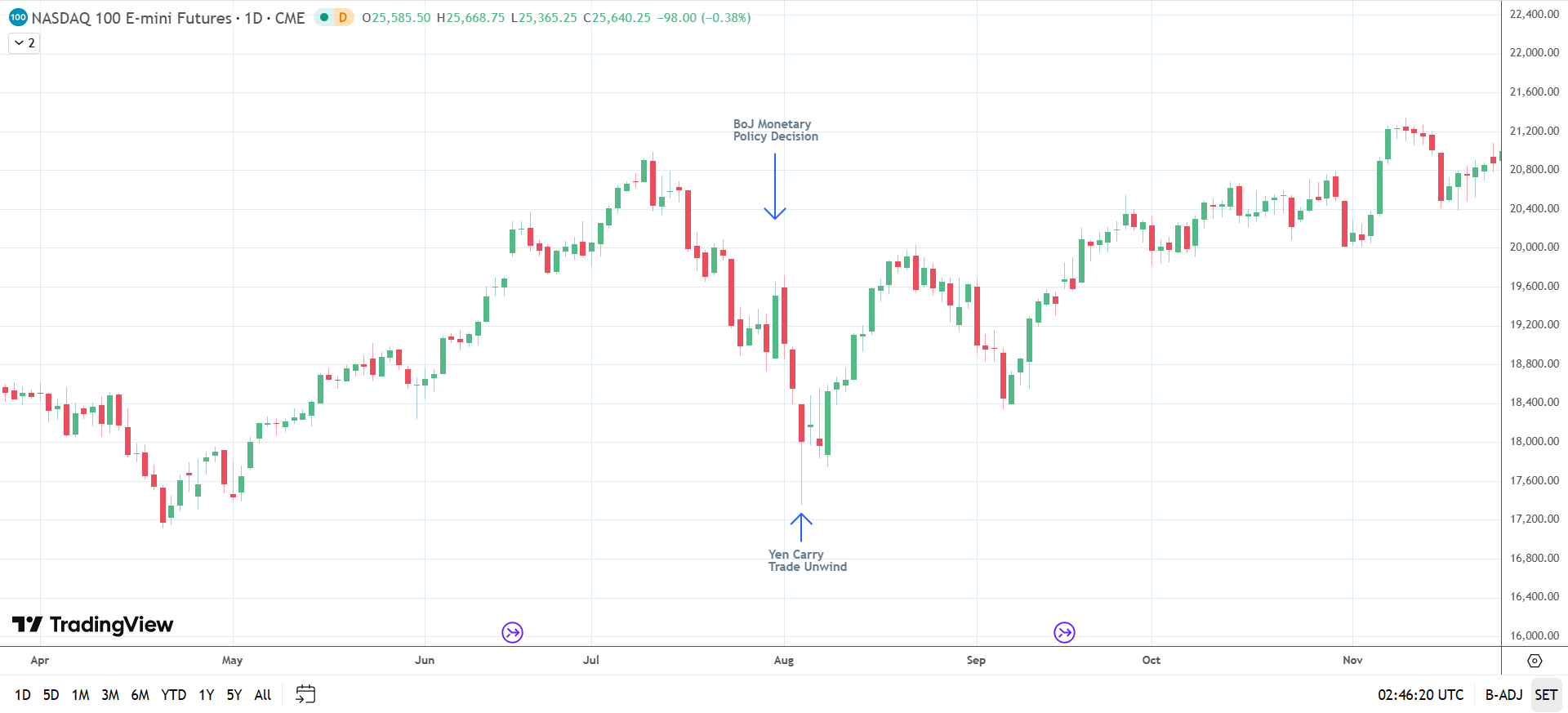
US Manufacturing and Earnings in Focus
US futures faced increasing selling pressure during the Asian session on February 2. The Dow Jones E-mini fell 184 points, while the Nasdaq 100 E-mini and the S&P 500 E-mini declined 98 points and 48 points, respectively.
Later on Monday, the US ISM Manufacturing PMI will influence risk sentiment. Economists expect the ISM Manufacturing PMI to rise from 47.9 in December to 48.3 in January. A higher PMI reading would indicate a less marked contraction across the manufacturing sector, supporting demand for risk assets.
However, traders should consider the employment and prices sub-components, given the Fed’s dual mandate. Falling employment and prices would support a more dovish Fed rate path. Lower borrowing costs would boost company earnings and equity valuations, overshadowing risks of a yen carry trade unwind.
Beyond the economic data, corporate earnings will also influence risk sentiment. Disney (DIS) is among the big names scheduled to release earnings results.
Strong earnings, coupled with softer manufacturing sector employment and prices, would support a rebound in US index futures, affirming the bullish medium-term outlook.
Key Technical Levels for Dow Jones, Nasdaq 100, and S&P 500
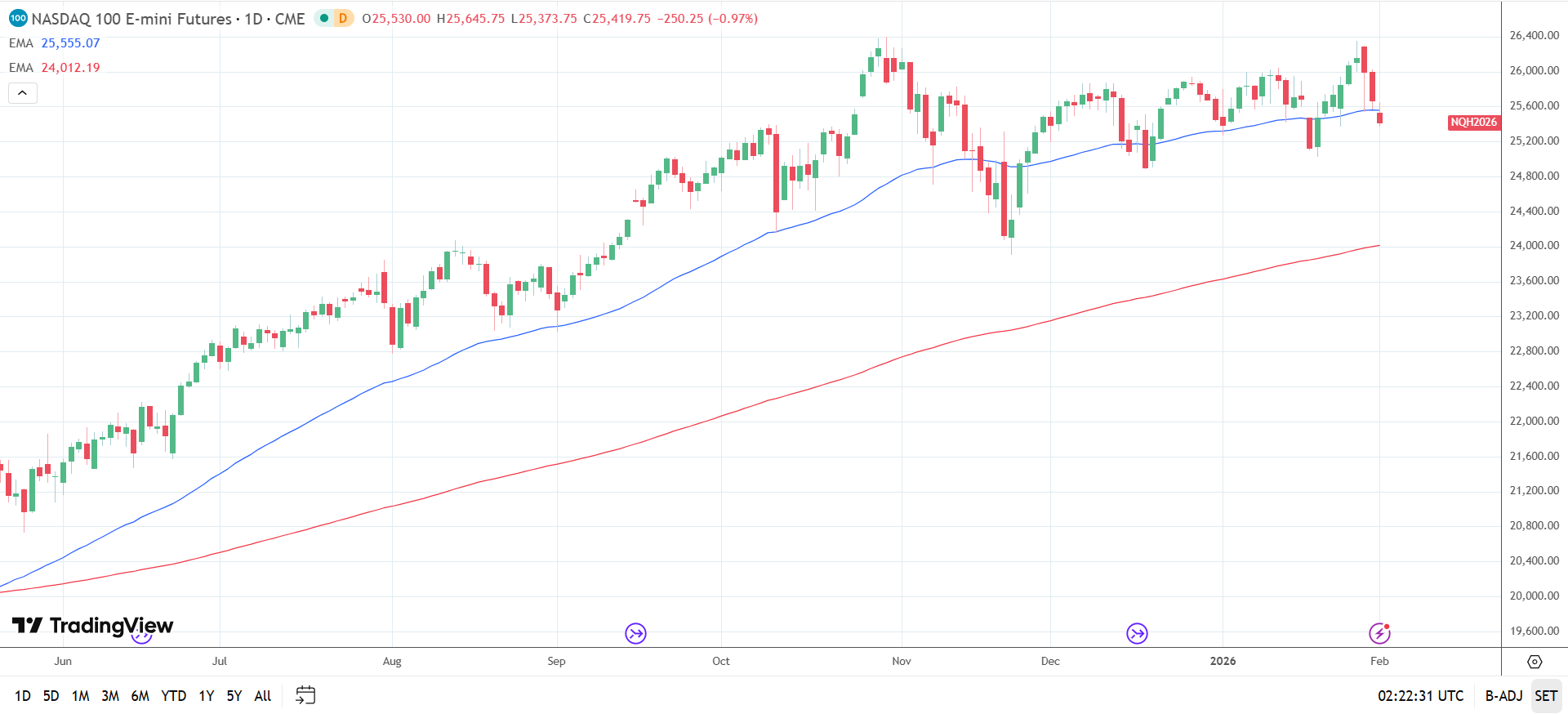
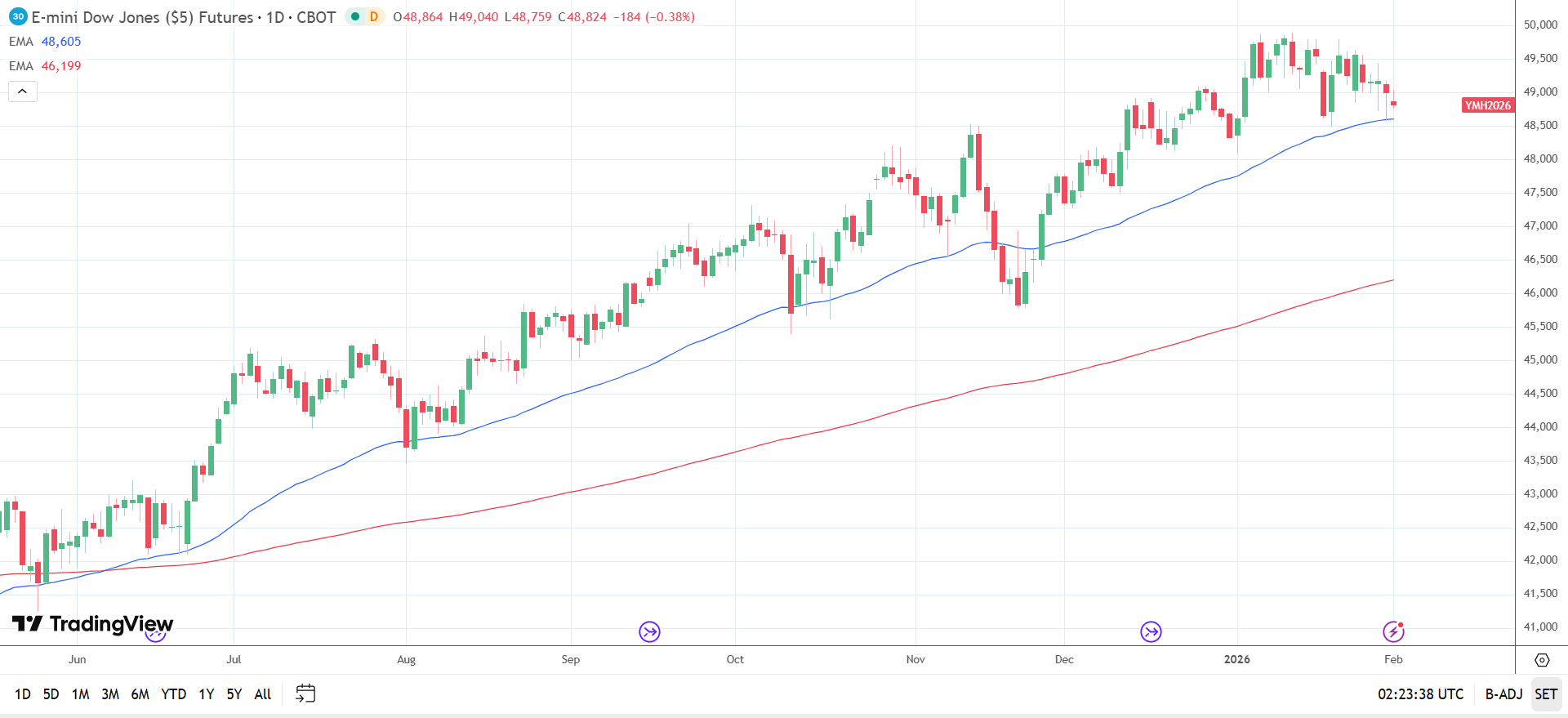
The latest pullback left the Nasdaq 100 E-mini trading below its 50-day EMA, while holding above the 200-day EMA. The EMA positions indicated a bearish near-term, but bullish longer-term outlook. Meanwhile, the Dow Jones E-mini and the S&P 500 E-mini remained above their 50-day and 200-day EMAs, indicating a bullish bias, aligning with favorable fundamentals.
Near-term trends will hinge on geopolitical tensions, earnings, US economic indicators, Fed chatter, and the BoJ’s policy stance. Key levels to monitor include:
Dow Jones
- Resistance: 49,000, the January 13 record high of 49,901, and then 50,000.
- Support: the 50-day EMA (48,605).
Nasdaq 100
- Resistance: the 50-day EMA (25,555), 26,000, and then the October 30 record high of 26,399.
- Support: 25,000 and then 24,500.
S&P 500
- Resistance: the January 13 high of 7,036, followed by 7,500.
- Support: the 50-day EMA (6,901) and then 6,500.
Outlook: Resilient US Economy and Earnings Affirm Bullish Outlook
In my opinion, the short-term price outlook remains cautiously bullish. Expectations of an H1 2026 Fed rate cut and positive market sentiment over Q4 earnings reaffirm the bullish medium-term outlook. These favorable fundamentals align with longer-term technicals for US index futures.
However, several events would challenge the bullish medium-term outlook, including:
- Increased geopolitical tensions.
- The Bank of Japan declares a higher-than-expected neutral interest rate (potentially 1.5%-2.5%). A sharply narrower US-Japan rate differential may trigger an unwind of yen carry trades. Such an event would invalidate the short-term outlook.
- Fed chatter and US economic data cool expectations of multiple Fed rate cuts in 2026.
- Corporate earnings and outlooks disappoint.
Conclusion: Constructive Bias Intact
In summary, the resilient US economy, a dovish Fed policy outlook, strong earnings, and a cautiously hawkish BoJ reinforce the short- and medium-term outlooks for US stock futures.
However, traders should monitor BoJ rhetoric, threats of yen intervention, and USD/JPY trends. Hawkish BoJ chatter, a dovish Fed, and more intervention threats could send USD/JPY toward 150, potentially triggering a yen carry trade unwind.
Despite risks of a yen carry trade unwind, new all-time highs for US stock futures remain in play if US economic data boosts bets on a June Fed rate cut. Fed rate cuts are likely to have a more lasting, longer-term effect on company earnings and equity valuations than narrowing US-Japan rate differentials on risk appetite.
Follow our live coverage and consult the economic calendar for real-time market updates.