XRP extends its losing streak amid a broader crypto market rout. The markets continued to react to Trump’s Fed Chair nomination.
Last week, President Trump nominated Kevin Warsh as the next Fed Chair. Economists view Warsh as a hawk, given his views on the Fed’s monetary policy stance and his desire to reduce the balance sheet.
Trump’s nomination announcement coincided with hotter-than-expected US producer prices, which signaled a more hawkish Fed rate path. The combination of a hawkish Fed Chair Powell, a potentially more hawkish incoming Fed Chair, and signs of sticky US inflation triggered a broad-based crypto sell-off.
The risk-off sentiment led to sharp XRP-spot and BTC-spot ETF outflows, fueling selling pressure.
While the latest pullback signaled a near-term bearish trend reversal, the medium-term outlook remains cautiously bullish.
Below, I will explore the key drivers behind recent price trends, the medium-term (4-8 weeks) outlook, and the technical levels traders should watch.
The Fed Policy Outlook Spooks Investors
Last week, Fed Chair Powell cooled bets on an H1 2026 Fed rate cut. During the FOMC press conference, Powell stated that elevated inflation and a resilient labor market supported holding rates steady. Powell added that policymakers would assess incoming data, with policy adjustments to be made on a meeting-by-meeting basis. The Fed Chair fueled uncertainty about the policy outlook, weighing on risk assets.
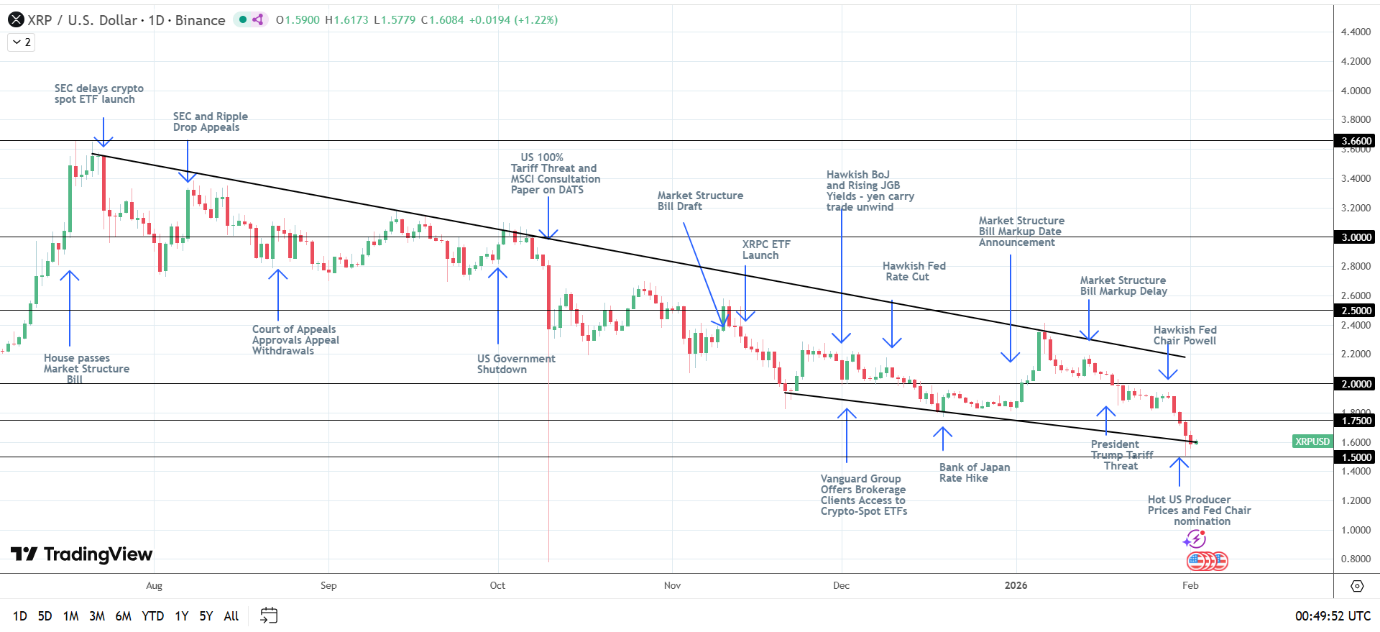
Stronger-than-expected US producer prices added to the negative sentiment, with Trump’s Fed Chair nomination accelerating the XRP plunge to crucial support levels. XRP found much-needed support at $1.5. XRP’s price action supported the bearish short-term outlook. However, holding above $1.5 kept the cautiously bullish medium-term price outlook intact.
Crucially, concerns about the Fed rate path impacted the US XRP-spot and US BTC-spot ETF markets, contributing to a slump in sentiment. The XRP-spot ETF market had net outflows of $52.26 million in the reporting week ending January 30, while the US BTC-spot ETF market saw net outflows of $1.61 billion.
Despite weekly net outflows, demand for XRP-spot ETFs recovered on January 30, supporting the constructive medium- to long-term bias. The US XRP-spot ETF market has seen $1.18 billion in total net inflows since trading began in November.
Bitcoin Price Forecast
Every new Bitcoin analysis as it publishes, today's technical signal and key levels, live price — on one page.
See all Bitcoin forecasts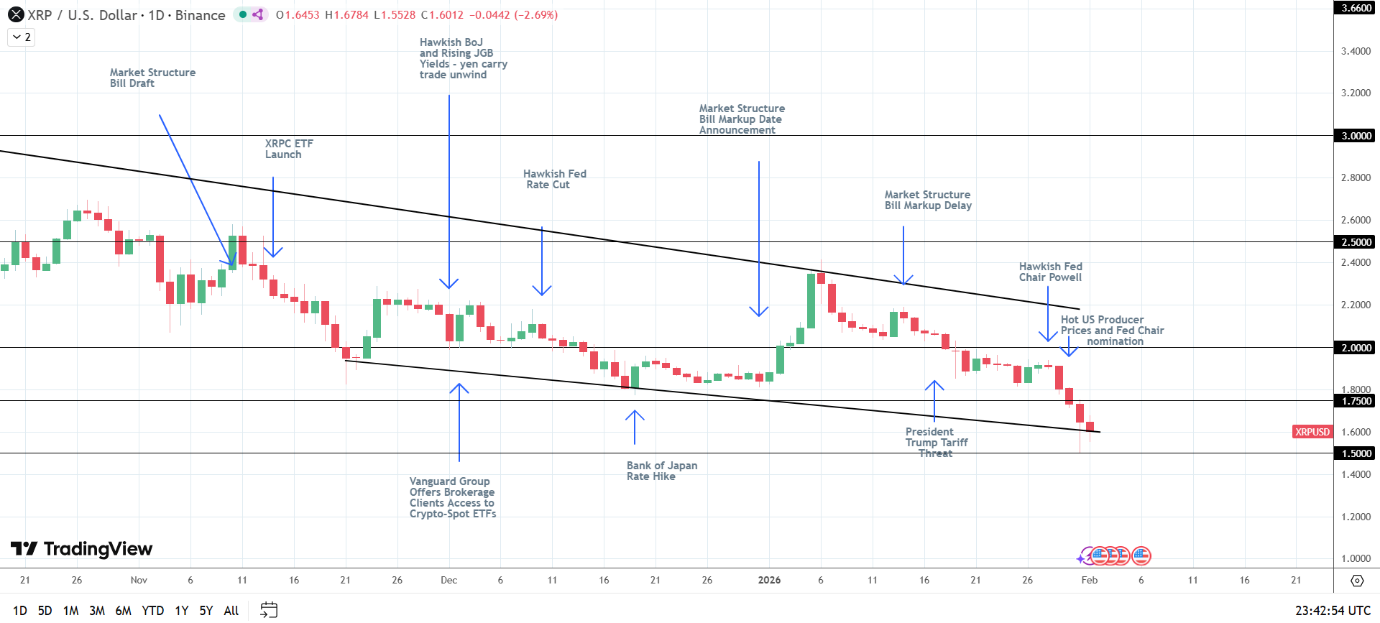
Crypto Legislation Takes Center Stage
On Monday, February 2, crypto-related legislation will take center stage. The US administration will hold a meeting with US banking and crypto representatives to facilitate talks on the US Senate Banking Committee’s draft text for the Market Structure Bill.
Last month, the US Senate Banking Committee postponed its markup vote on draft text after Coinbase (COIN) withdrew its support. Coinbase CEO Brian Armstrong stated that the draft text killed rewards on stablecoins, allowing US banks to ‘ban their competition.’
The battle between TradFi and DeFi will begin in earnest on Monday. Notable attendees from the banking fraternity include the American Bankers Association (ABA) and the Independent Community Bankers of America (ICBA).
The ABA has previously targeted the US digital asset space. In 2023, Senator Roger Marshall acknowledged that he and Senator Elizabeth Warren drafted the Digital Asset Anti-Money Laundering Act, with assistance from the ABA. The Digital Asset Anti-Money Laundering Act proposed a banking-style anti-money laundering and countering the financing of terrorism (CFT) framework that could have killed crypto advancement on Main Street.
Senator Warren was dubbed the leader of the ‘Anti-Crypto Army,’ inviting the CEOs of the largest US banks to attend a Banking Committee hearing on Capitol Hill. JPMorgan CEO Jamie Dimon famously declared:
“If I were government, I would close it down.”
The ABA was involved in more controversy in 2025, requesting that the Office of the Comptroller of the Currency (OCC) delay Ripple and Circle’s approvals for chartered banking licenses.
The ABA’s protective actions undermined President Trump’s push to make America the center of crypto innovation, setting the stage for a heated Monday session.
Progress toward crypto-friendly legislation remains key to XRP’s bullish medium- to long-term outlook. Analysts view the passing of the Market Structure Bill as pivotal to increased XRP adoption.
XRP Price Forecast: Short-, Medium-, and Long-Term Targets
This week’s sell-off signaled a bearish trend reversal, indicating a negative short-term outlook (1-4 weeks), with a target price of $1.5.
However, hopes for Fed rate cuts, optimism that the Market Structure Bill will progress, and increased XRP utility continue to reinforce the bullish medium- to long-term price projections:
- Medium-term (4-8 weeks): $2.5.
- Longer-term (8-12 weeks): $3.0.
Key Downside Risks to the Bullish Medium-Term Outlook
Several scenarios could derail the constructive bias. These include:
- A hawkish Bank of Japan, with a higher neutral interest rate (potentially 1.5%-2.5%). A hawkish BoJ rate path would narrow US-Japan rate differentials, potentially triggering a yen carry trade unwind, as seen in mid-2024. A yen carry trade unwind would validate the bearish trend reversal.
- Strong US economic data and fading bets on an H1 2026 Fed rate cut.
- Delays and/or partisan opposition to the Market Structure Bill.
- Extended periods of XRP-spot ETF net outflows.
These factors would weigh on demand for XRP, pushing XRP below $1.5 and reaffirming the bearish trend reversal.
Technical Analysis: Levels to Watch
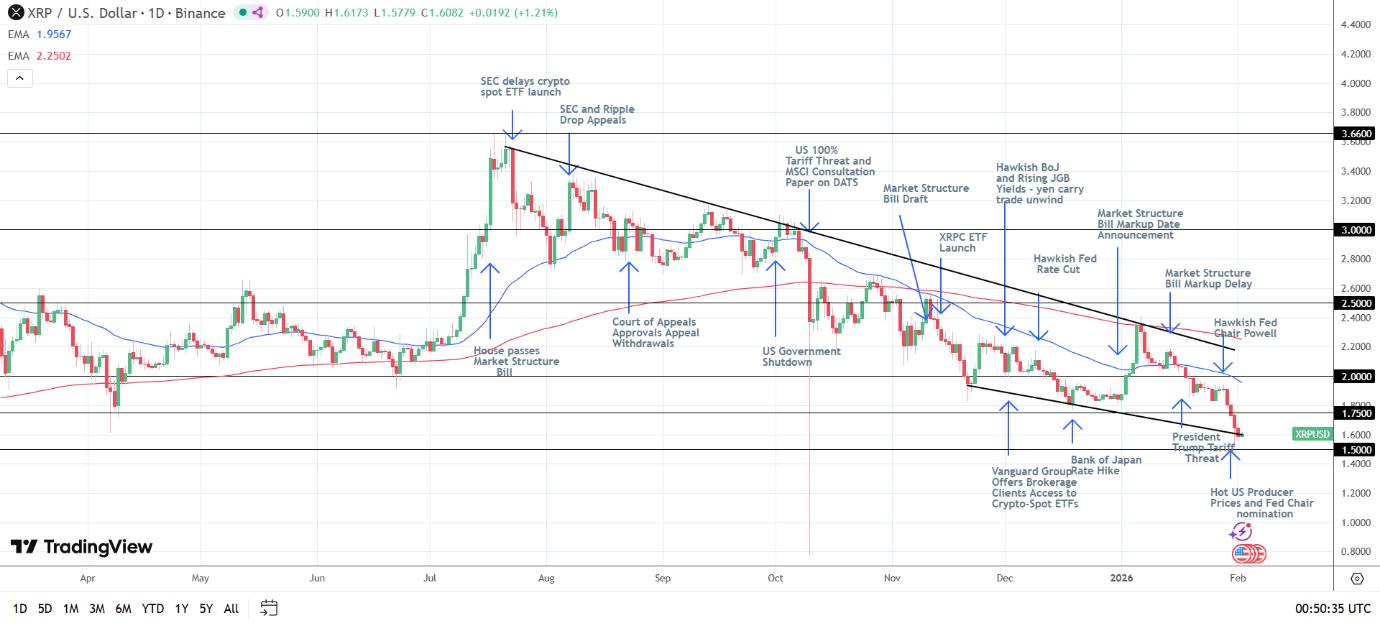
XRP fell 3.47% on Sunday, February 1, following the previous day’s 3.98% loss to close at $1.5890. The token came under heavier selling pressure than the broader crypto market cap, which dropped 2.7%.
Last week’s reversal left XRP trading well below its 50-day and 200-day EMAs, signaling a bearish bias. However, several positive fundamentals continue to offset bearish technicals, supporting a bullish medium-term outlook.
Key technical levels to watch include:
- Support levels: $1.50 and then $1.0.
- 50-day EMA resistance: $1.9567.
- 200-day EMA resistance: $2.2502.
- Resistance levels: $1.75, $2.0, $2.5, and $3.0.
On the daily chart, a breakout above $1.75 would pave the way toward the 50-day EMA and $2.0. A sustained move through the 50-day EMA would indicate a near-term bullish trend reversal, bringing $2.2 into sight. A break above $2.2 would bring the 200-day EMA into play.
A sustained move through the EMAs would reinforce the bullish medium-term price targets.
Fundamental Events Driving Near-Term Price Action
Near-term price drivers include:
- XRP-spot ETF flows.
- US economic indicators and the Fed’s policy stance.
- Crypto-related regulatory developments.
- The Bank of Japan’s neutral rate and rate path.
- Increased geopolitical tensions.
Bearish Structure Spotlights $1.5 as Key Support
Last week’s sell-off signaled a bearish trend reversal and invalidated the bullish short-term outlook. However, $1.5 provided crucial support. A break below $1.5 would enable the bears to target the psychological $1 level. If breached, the October 10 flash crash low of $0.7773 (Binance) would be the next key support level. Importantly, a drop below $1.5 would reaffirm the bearish short-term outlook and validate the bearish structure.
Conversely, moving above $2.0 would pave the way toward the upper trendline. A sustained move through the upper trendline would indicate a bullish trend reversal, invalidating the bearish structure, and affirming the constructive medium-term bias.
- Short-term (1-4 weeks): $1.5.
- Medium-term (4-8 weeks): $2.5.
- Longer-term (8–12 weeks): target of $3.0.
XRP Outlook Hinged on Crypto Regulations and ETF Flows
Looking ahead, updates from Monday’s White House session and the US Senate Banking Committee will be key for XRP’s price outlook. Progress toward a US Senate Banking Committee draft text for the Market Structure Bill would likely boost XRP demand.
However, geopolitical tensions, central bank rhetoric, and XRP-spot ETF flow trends will also dictate near-term price trends.
A more dovish Fed policy stance and a lower BoJ neutral rate (potentially 1%-1.25%) would lift sentiment. Robust inflows into US XRP-spot ETFs and the progress of the Market Structure Bill would reinforce the positive medium-term outlook.
In summary, these events support a medium-term (4–8 weeks) move to $2.5. The US Senate’s passing the Market Structure Bill would affirm the longer-term (8–12 weeks) price target of $3.0.
Beyond 12 weeks, these events are likely to drive XRP to its all-time high of $3.66 (Binance). A breakout above $3.66 would support a 6- to 12-month price target of $5.