


International markets have come under renewed pressure on Wednesday as stronger U.S. inflation has reinforced concerns about restrictive interest rates. The dollar has strengthened after the release, while Treasury yields rose and equities weakened in the United States.
The central-bank issue is the interaction between energy costs and monetary policy. Investors will have to weigh an immediate inflation shock against the possibility that containing it could require more expensive financing.

CPI Surprises in America
The Bureau of Labor Statistics reported that September consumer prices increased 0.6% from August on a seasonally adjusted basis. Annual headline inflation accelerated to 3.7% from 3.4%. Core prices, excluding food and energy, rose 0.3% month over month and 2.6% over the year. Gasoline increased 9.1% monthly and accounted for more than half of the headline monthly advance. Shelter costs also rose 0.4%, showing that the report contained some pressures beyond fuel.
Bond markets responded quickly. The 2-year Treasury yield jumped above 4.91%, and the 10-year jumped above 5.29%. Markets will continue to have quite a bit of noisy behavior and, as a result, the longer-term outlook will be focused on whether or not the Federal Reserve will have to tighten monetary policy to contain some of the borrowing and spending to keep inflation under control.
The Implication for Foreign Exchange Is Very Obvious
Currency markets reflected some repricing, as the euro and sterling fell. The October Federal Reserve increase percentages now read 47% for the month of October, compared with approximately 20% before CPI. The numbers describe investor expectations rather than a policy commitment. A sustained increase in expected U.S. returns could support the dollar.
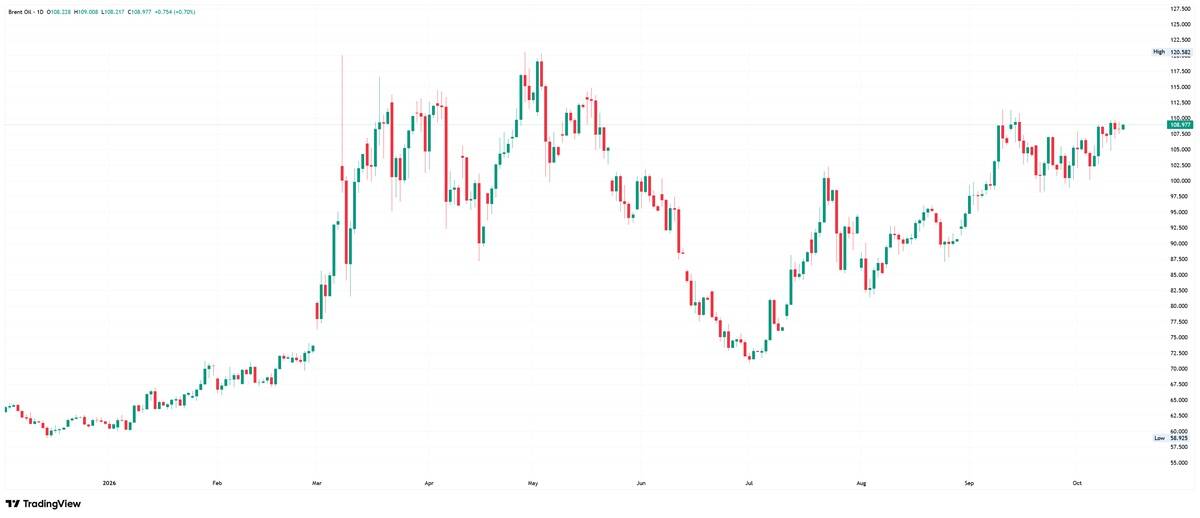
Energy remains a separate source of uncertainty. Reuters reported that Brent futures were at $106.60 shortly after the release, while WTI was around $95.80. Saudi Arabia’s energy minister said an attack on an Aramco administrative building caused a limited fire, although it is not expected to affect production.
Brent Oil Price Forecast
Every new Brent Oil analysis as it publishes, today's technical signal and key levels, live price — on one page.
See all Brent Oil forecastsMore Attacks
Reuters also reported that U.K. Maritime Trade Operations described projectile strikes on two vessels in the Strait of Hormuz on Tuesday. This could raise supply concerns without establishing that every incident has reduced production.
Persistent energy costs can squeeze importers’ purchasing power and corporate margins while potentially improving export revenues for producing countries. Currency effects do not necessarily have to be uniform. A commodity exporter might benefit from stronger receipts but still face pressure if investors reduce risk or favor dollar assets. This will be one of the biggest themes in the forex world.
EU Sovereign Debt
Europe also faces a fiscal dimension. A European Commissioner said on Wednesday that he saw no signs of a new euro area sovereign debt crisis while urging prudent fiscal policy. The report described France’s 10-year yield premium over Germany as hovering near 1.4% again amid budget concerns.
My interpretation is that the spread deserves attention separately from outright yields, as it reflects the additional compensation that investors see for holding French debt relative to the regional benchmark.
EU Monetary Policy
European monetary policy is another form of complication. Reuters reported that Christine Lagarde described energy as the predominant, but not exclusive, driver of euro area inflation and said that the ECB was watching for broader effects, including wage demands. For currencies, the relevant question is how European policy expectations change relative to U.S. expectations.
Equities illustrate the tension between earnings and financing costs, as the S&P 500 and the Nasdaq both fell early in the United States. That being said, the market continues to look somewhat buoyant from a longer-term standpoint.
The next major policy checkpoint is the Federal Reserve’s October 27 and 28 meeting, confirmed by its official calendar. Until then, the principal questions are whether or not energy disruptions persist, whether inflation pressures broaden, and whether earnings can withstand higher financing costs. Thursday does feature PPI in the United States and gives us yet another read on inflation.


