



Gold Market Update: U.S. Payrolls in Focus
Gold prices are on track for a second consecutive weekly decline, reflecting investor caution ahead of pivotal U.S. labor market data. As of Friday, spot gold has maintained a position above the week’s low of $2,281.68, yet it is projected to close the week over 1% lower. This downturn follows a period of substantial gains, with gold retreating from a record peak of $2,431.29 reached in April.
At 10:51 GMT, Gold (XAU/USD) is trading $2298.13, down $5.67 or -0.25%.

Recent Price Movements
The sharp pullback in gold prices, which have plummeted more than $130 from the April high, can be attributed to diminished geopolitical tensions and a recalibration of interest rate expectations. Notably, efforts by Egypt to reboot peace talks between Israel and Hamas have spurred hopes for a ceasefire, reducing demand for safe-haven assets like gold.
Federal Reserve’s Stance
The Federal Reserve’s recent communications have underscored a cautious approach toward rate cuts, influenced by weaker-than-expected inflation figures. Despite this, market participants are assigning a 73% probability to a rate reduction by November, as indicated by the CME’s FedWatch Tool. High interest rates have continued to dampen the attractiveness of gold, which does not yield interest.
Economic Indicators and Forecasts
Investors are closely watching the U.S. non-farm payrolls report, expected to show a decrease in job growth with 240,000 new jobs in April, down from 303,000 in March. This data, coupled with the steady unemployment rate of 3.8% and an anticipated 4% annual increase in average hourly wages, will provide deeper insights into economic conditions and could potentially influence the Federal Reserve’s direction on monetary policy.
Market Forecast
With the gold market showing a downward trend and testing the 50-day moving average at $2,234.54, the outlook appears bearish in the near term. The upcoming labor market report could further sway market sentiment, particularly if the data suggests continued economic strength, which may delay any potential rate cuts by the Fed. Traders should prepare for possible increased volatility around these economic releases.
Technical Analysis
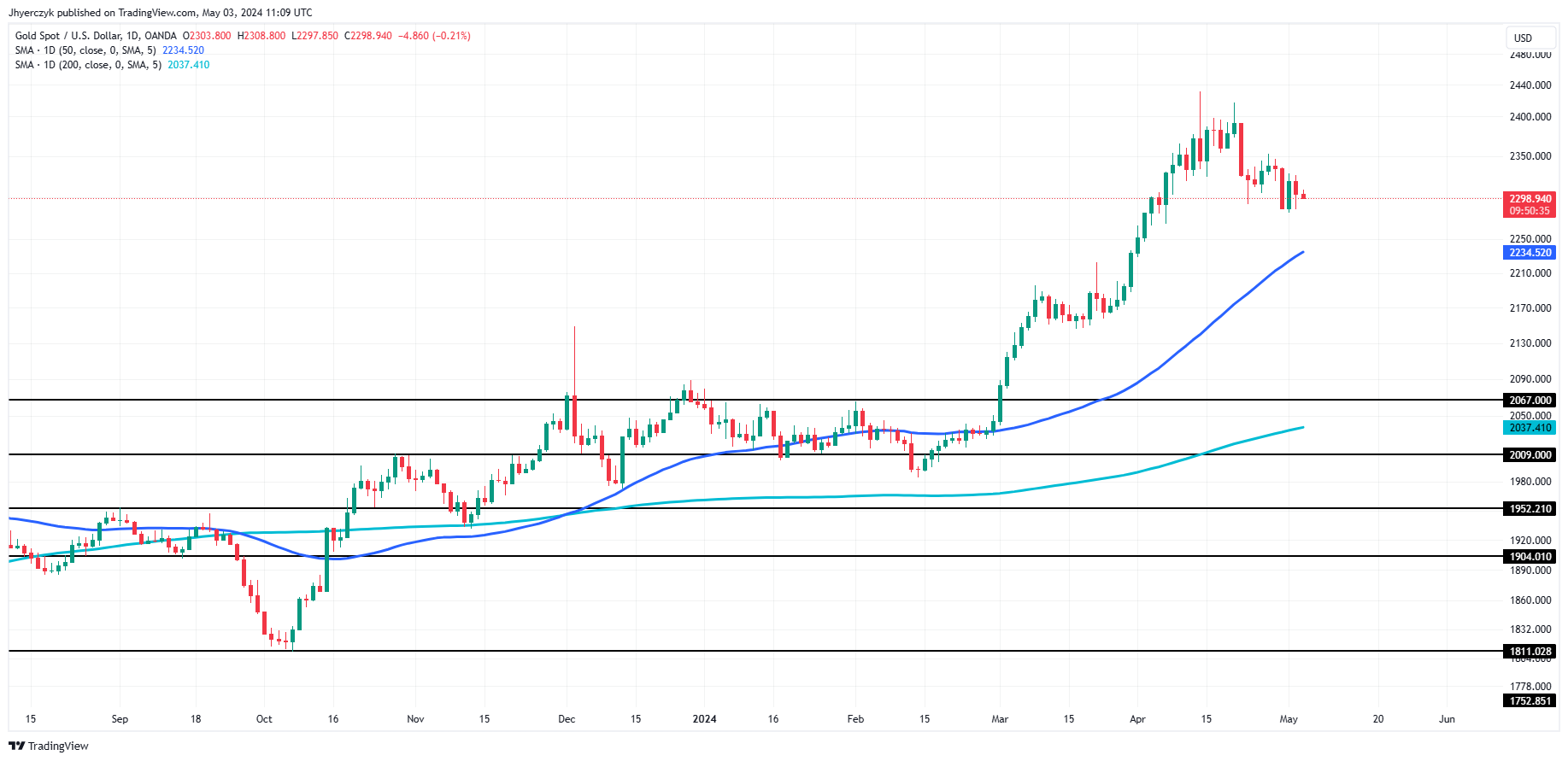
During the course of this three-week sell-off, the short-term trend has turned down, but the intermediate and long-term trends have remained intact.
If downside momentum continues and $2281.68 fails as support then look for a further decline into the 50-day moving average at $2234.51.
A sudden reversal to the upside will change the short-term trend to up if the move can take out the top at $2352.64.


