



Gold & Silver Outlook: Iran Tensions Support Safe Havens as U.S. Inflation Test Looms
Tuesday saw strengthening gold and silver fundamentals driven by a weaker dollar and some returning geopolitical uncertainties, although the picture is still quite complex with uncertainty over whether the Federal Reserve will begin another interest rate hike. This week’s focus is now on the crucial pair of U.S. inflation reports which will dictate if the stronger employment data will drive policy to tighten.
The Producer Price Index (PPI) is due Thursday morning, to be followed by the Consumer Price Index (CPI) on Friday morning. This Thursday’s PPI report will be of more interest compared to the last few reports, as speculation of another Fed interest rate hike in September has been enhanced by the August jobs report last week showing solid job growth. Persistent inflation will be a tight gauge for policy, a major headwind for non-yielding precious metals. Softer inflation will weaken that case and be supportive of a tighter policy outlook.
We have geopolitics again forming a backdrop. Iran said it would continue to respond to the U.S. and continued to support the threat of closing the Strait of Hormuz. This is adding the traditional safe haven of gold, but it is creating an unusual situation in that reduced regional supplies are also creating an inflationary situation in rising energy and diesel costs. The higher energy costs are creating longer lasting global interest rates.
Tuesday saw the dollar weakening, creating a better overall monetary situation for precious metals. Gold is also benefiting from longer term institutional buying, with continued geopolitical tensions, coupled with slide purchasing, creating a major structural demand for gold. A Reuters survey showed these as the two driving forces for gold in 2026, geopolitical tensions, and Central Bank buying.
Like gold, silver is sensitive to the dollar, yields and geopolitical risk, but silver has a unique cyclical dimension from its heavy industrial use. This makes Tuesday’s gain in silver a reflection of the broader focus on precious metals as the dollar weakens, and while the market waits for more definition to come on U.S. inflation and the Fed.
Fundamental Bias: Gold bullish with a lean towards being moderately bullish, Silver bullish with a lean towards being moderately bullish. The U.S. PPI and CPI will be the next key data releases to drive the markets.
Gold Technical Analysis: XAU/USD Rejected Below $4,422 as $4,365 Support Becomes Critical
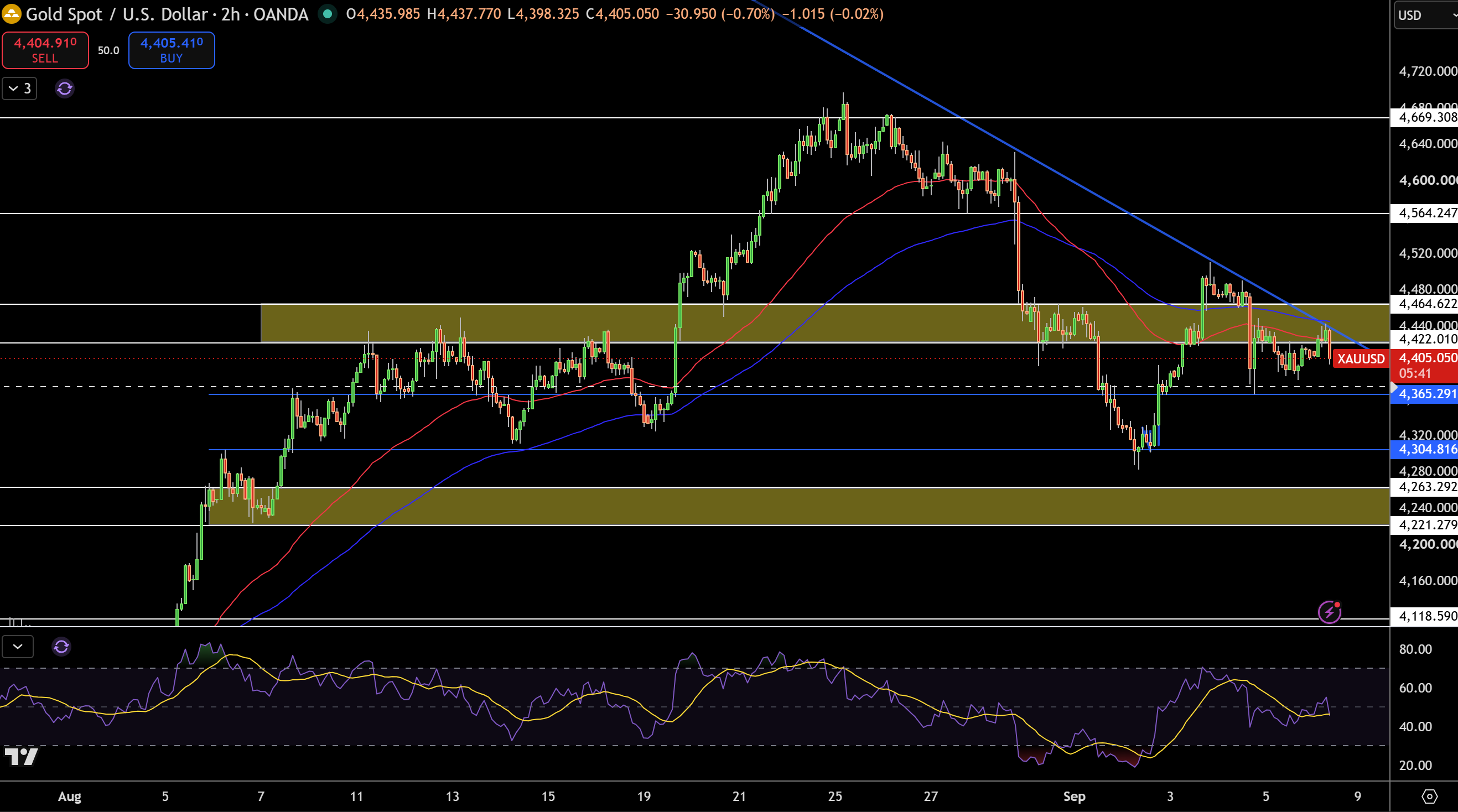
Gold is currently trading at $4,405 on the 2-hour chart as another rejection was seen from the $4,422 to $4,465 resistance zone. What is worth noting is that price has on multiple attempts broken the descending trendline, and the most recent rebound from $4,305 has lost its momentum. This adds to the short-term bearish structure.
The first of my concerns is $4,365. A clean break beneath this level would target $4,305 and the larger $4,263 to $4,221 demand area. In the bullish scenario, $4,422 is the first level, followed by $4,465. An attack and break above here would open the potential for $4,564.
RSI is currently in neutral which shows a lack of momentum in the rebound, which adds to the bearish sentiment I have with gold below $4,422 to $4,465. A strong 2-hour close above $4,465 would negate this stance, but until price is able to break the descending trendline, $4,365 will remain the level of interest.
Gold Price Forecast
Every new Gold analysis as it publishes, today's technical signal and key levels, live price — on one page.
See all Gold forecastsSilver Technical Analysis: XAG/USD Compresses Below $67.21 as Triangle Structure Nears a Break
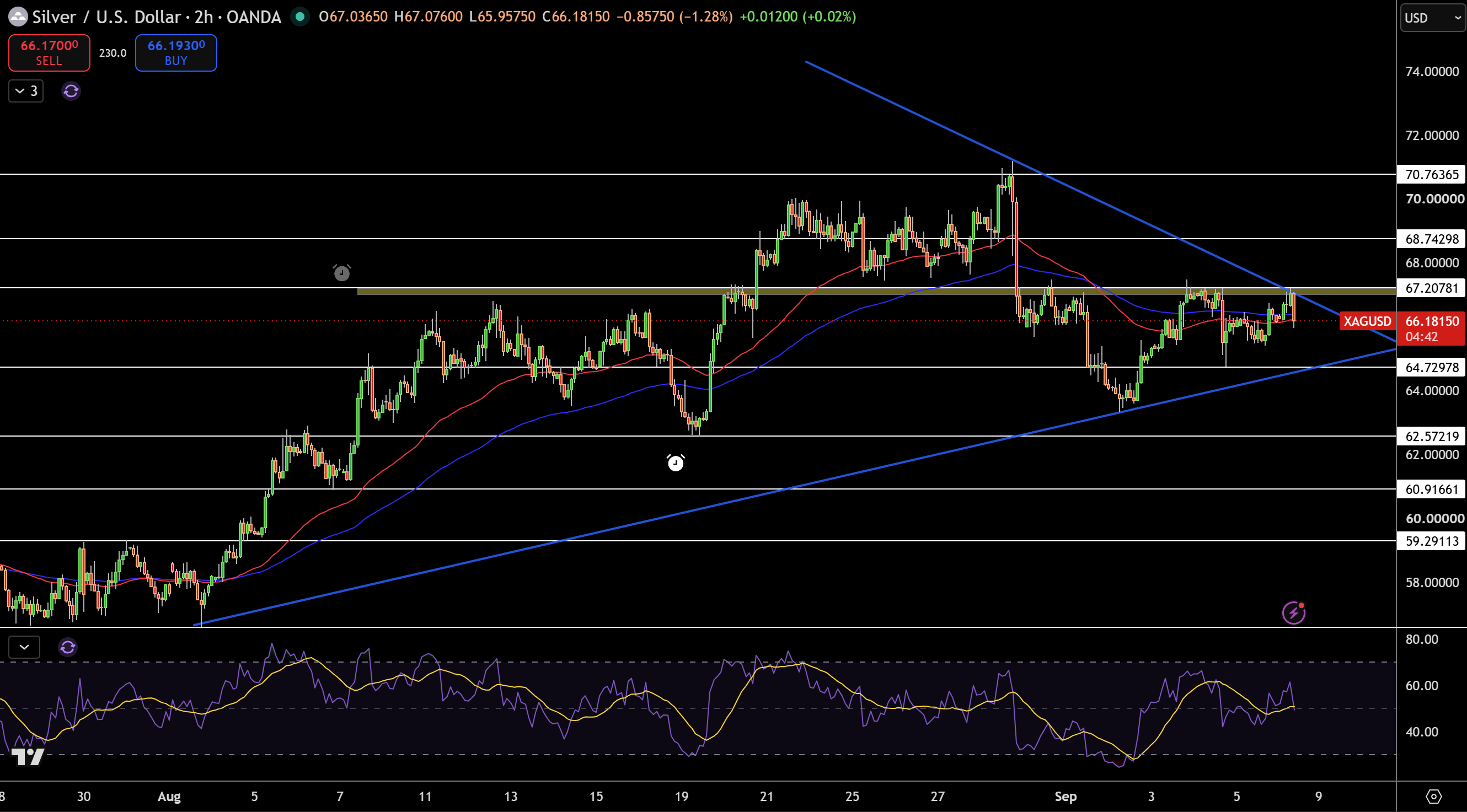
Silver is currently trading at $66.18 and what is worth noting here is the descending trendline and the rising support line’s triangle structure. We now are seeing a strong compression below the $67.21 resistance zone, making the next break critical.
Immediate support rests around $64.73 and $62.57. If bulls are to drive this up, $67.21 will need taking out. Above that, $68.74 and $70.76are within range. If $64.73 breaks down, attention will go to the $62.57 support zone.
Momentum looks neutral and RSI is even. I favor being neutral, but am slightly biased to the downside as long as silver is below $67.21. If silver closes above $67.21 with strength, my bias would shift to the upside. A break of $64.73 would put the downside in focus and $62.57 would be the target.