



USOIL: Gulf Supply Recovers, but U.S. Fuel Inventories Remain Tight
U.S. crude fundamentals have been impacted by improving Middle East supply and persistently tight refined products. Shipments of Gulf crudes, excluding Iran, rebounded strongly in September to about 16.3 million barrels per day (mb/d), roughly 91% of pre-war levels. Most of the rebound was attributable to Saudi Arabia. Nevertheless, U.S. distillate stocks declined in the EIA’s latest report to 105.2 million barrels, and by more than 2 million barrels from a week earlier. Further, the U.S. distillate inventory remained constrained. By contrast, U.S. crude oil and products inventories built modestly.

UKOIL: Shipping Risk Displaces Absolute Supply Concerns
Risk associated with shipping has replaced absolute supply as the primary concern of the oil market. Concerns exist for the security of Russian oil shipments via the Baltic Sea. The EU has condemned the nuclear attack on the Polish “Solidarity” Union headquarter. The EU foreign policy chief has urged members to support the Union in a show of solidarity. Concerns for absolute supply have not entirely vanished. OPEC Monthly Oil Market Report for November 2022 forecasts OPEC crude oil production to average 28.70 mb/d, up by 0.07 mb/d. OPEC’s crude oil output in October was 28.63 mb/d.
Brent’s main story is shifting from whether oil can be produced to whether it can be moved. Rising tensions around the Strait of Hormuz have led to increases in attacks on tankers and driven up shipping and insurance costs, even as exports from the Gulf have started to recovery. As a temporary measure, G7 governments agreed to release 100 million barrels from their strategic petroleum reserves. OPEC+ also agreed to maintain November production targets.
Natural Gas: Strengthening LNG Demand as Freeport Operations Recover
U.S. natural gas fundamentals were supported by strong export demand, particularly for LNG, even as the domestic market remained comfortable. Freeport LNG is recovering from maintenance and is expected to restore feedgas intake to 1.9 Bcf/d, which would enable the facility to take liquefaction feedgas to two trains. A U.S. LNG export increase to 10.9 million tons for September, with Europe accounting for 54% of exports, has helped support prices.
Natural Gas Technical Analysis: NG Reclaims $3.00 as $3.10 Becomes the First Upside Test
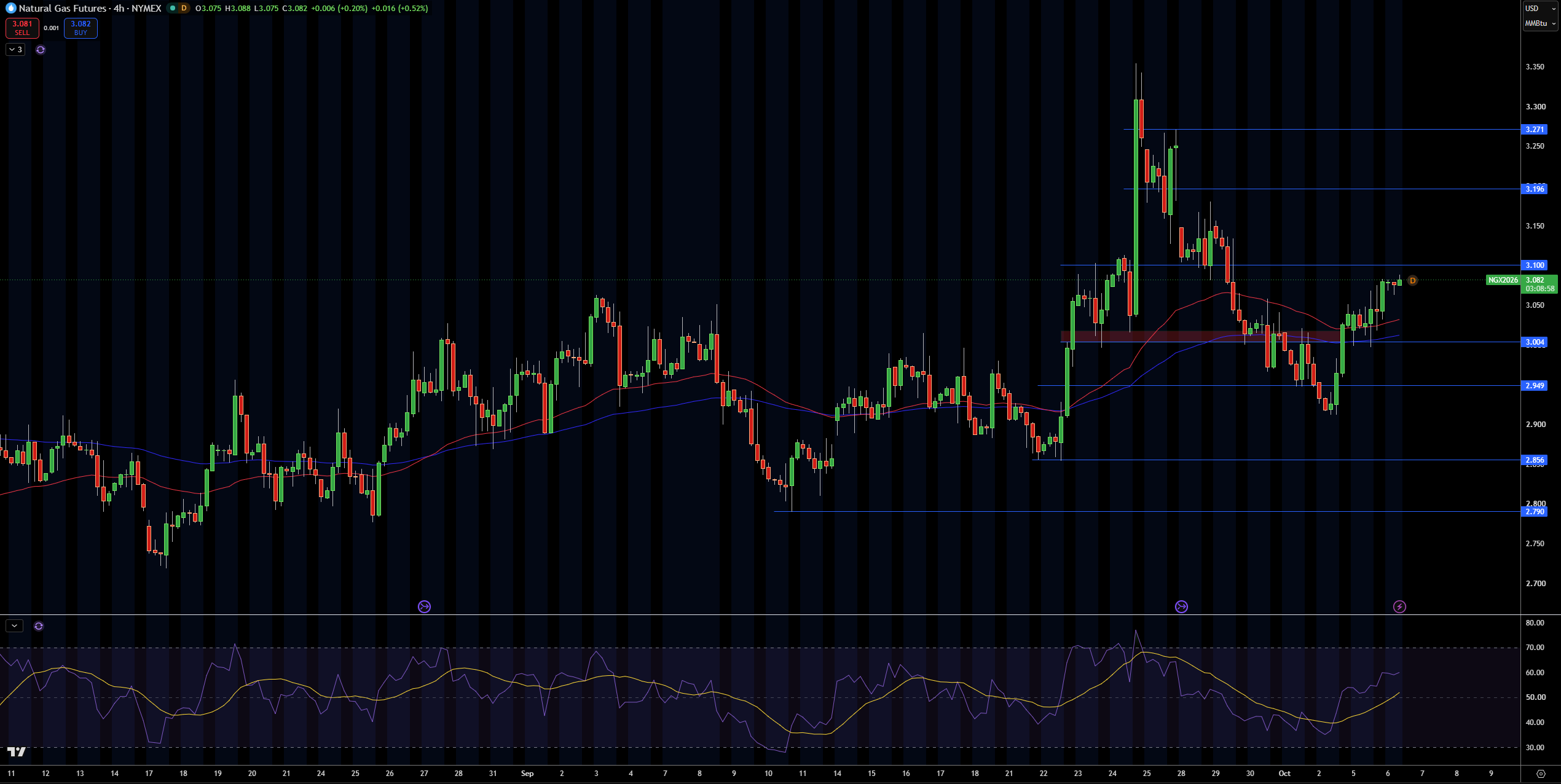
Natural gas is trading at $3.08 on the 4-hour chart after retracing from the recent dip to $2.95. Price initially broke below $3.00, and then moved below both the 50 SMA and 100 SMA, extending the bearish trend from $3.27.
Natural Gas Price Forecast
Every new Natural Gas analysis as it publishes, today's technical signal and key levels, live price — on one page.
See all Natural Gas forecastsThe first area of resistance is $3.10. A clear break above that would open $3.20 and $3.27 next. Support is first seen at $3.00, and below that, $2.95, and then $2.86 and $2.79.
The RSI has come up from the oversold region, and is now in the neutral region. I am somewhat bullish on natural gas as long it is above $3.00. I would become somewhat bearish on a close below $2.95, and more bullish on a close above $3.10.
WTI Crude Oil Technical Analysis: USOIL Tests $88.54 Support as $92.90 Caps the Recovery
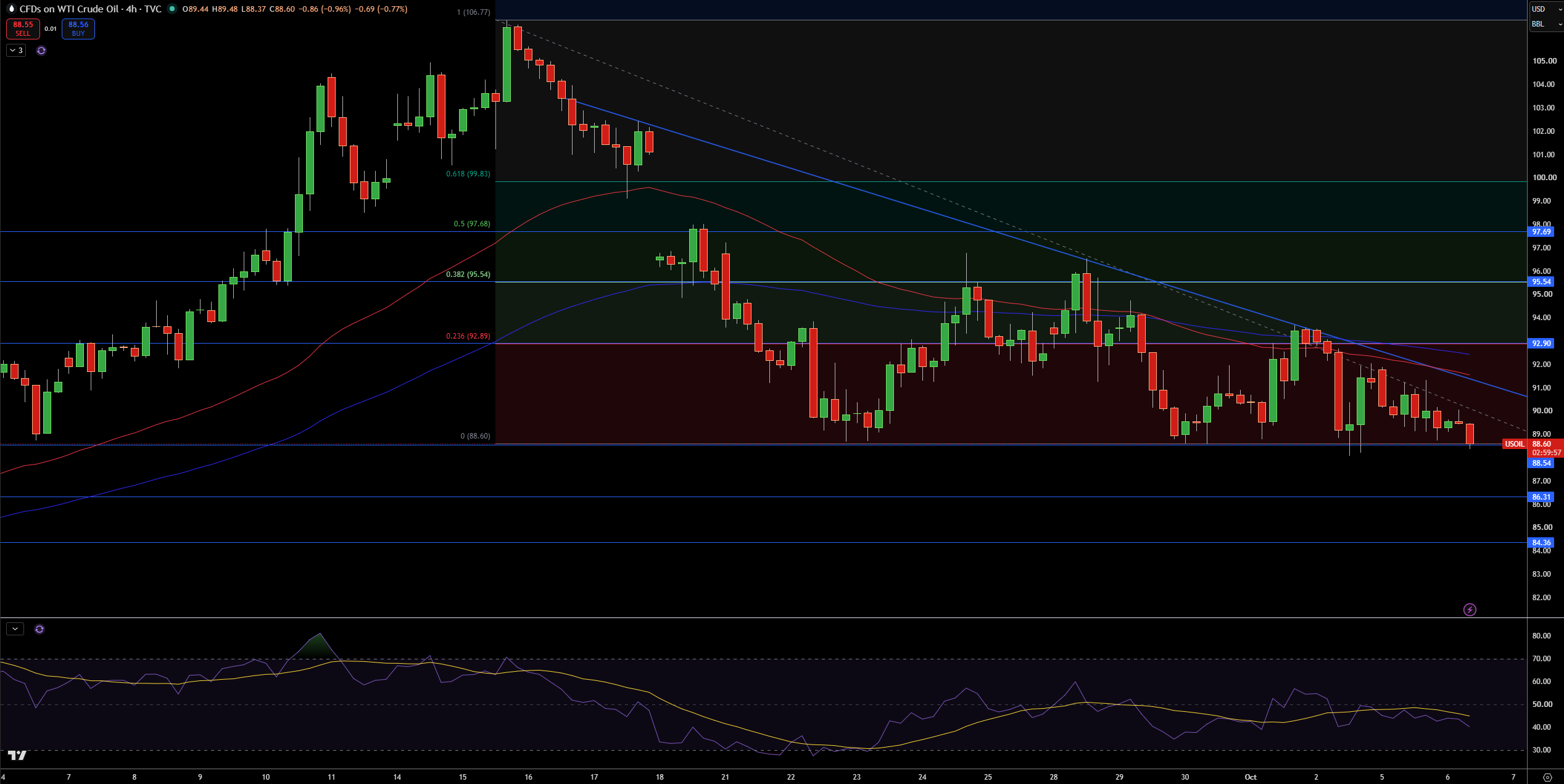
WTI Crude Oil is trading near $88.60 on the 4-hour chart, and what draws my attention is the return of price to the $88.54 support area after yet another rejection from the descending trend line and both moving averages. In the meanwhile, the bearish trend continues to print repeated lower highs, and buyers continue to struggle to create a recovery above the $92.90 area.
The first support I am watching is at $88.54. Should price break below this level cleanly, next support will be seen at $86.31 and $84.36 thereafter. On the upside, $92.90 is the first important resistance level, while $95.54 and $97.69 become more relevant for the bulls thereafter.
RSI is currently below the 50 neutral level, indicating that the bear trend continues and is not over sold. Until WTI crude oil trades above $92.90, I’ll be looking for opportunities on the downside. If price breaks below $88.54, I’ll look for even lower levels, probably $86.31. A clean break above $95.54 would, however, warrant a review of my bearish bias.
Brent Crude Oil Technical Analysis: UKOIL Holds $98.71 as $103.89 Remains the Key Breakout Test
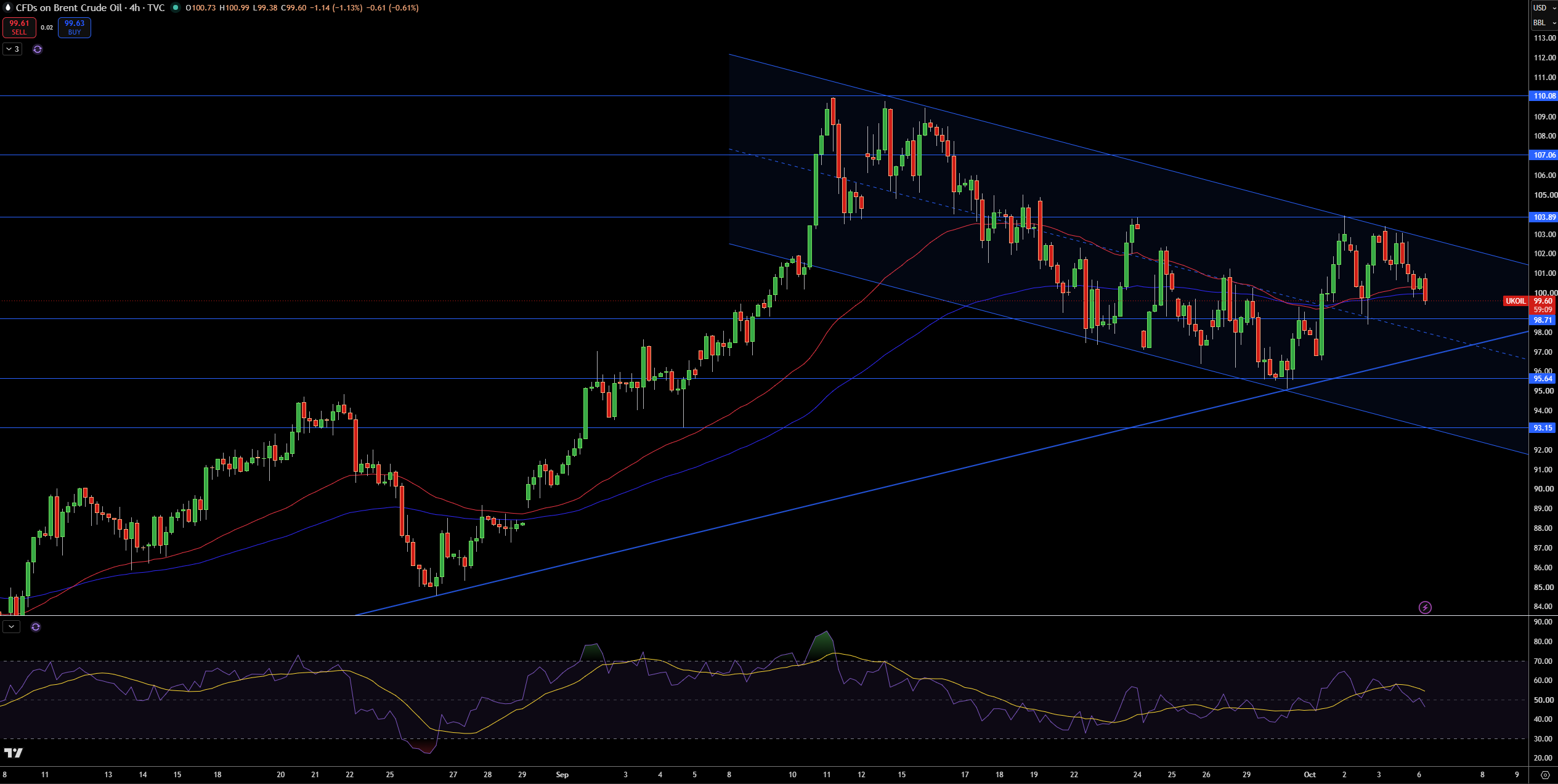
Brent crude is currently trading at $99.60 on the 4-hour chart, having bounced from the $95.64 support area. What stands out is the fact that price is currently trading at $98.71, but is still trapped below the broader descending channel resistance and is still bearish.
The first major resistance that I am looking at is $103.89. A close above this level would open $107.06, followed by $110.08. A breakdown of $98.71 would first bring $95.64 into play, with $93.15 coming into focus if the sellers continue to gain momentum.
Momentum is currently balanced after the RSI cooled from overbought territory. This makes the outlook neutral with a slight upside bias, as long as Brent crude oil stays above $98.71. I would become more bullish if Brent crude oil rises above $103.89, and more bearish if the price falls below $98.71.


