
EIA’s October Storage Forecast Takes the Momentum Away from the Heat Trade
September natural gas is bouncing Wednesday but the rally attempt is running into a wall that hot weather alone cannot tear down. The Energy Information Administration projected U.S. storage would reach 3,985 Bcf by the end of October, the highest level in 10 years and 5% above the five-year average.
That number landed Tuesday and immediately changed the conversation from this week’s heat to how much gas the country is carrying into winter. The contract is testing the lower boundary of a key retracement zone and needs to clear the pattern of lower highs before the bounce means anything beyond short-covering.
At 10:58 GMT, September natural gas futures were trading at $2.787, up $0.020 or 0.72%. On Tuesday, the contract settled at $2.767, down $0.027 or 0.97%.

Daily September Natural Gas Futures Technical Analysis
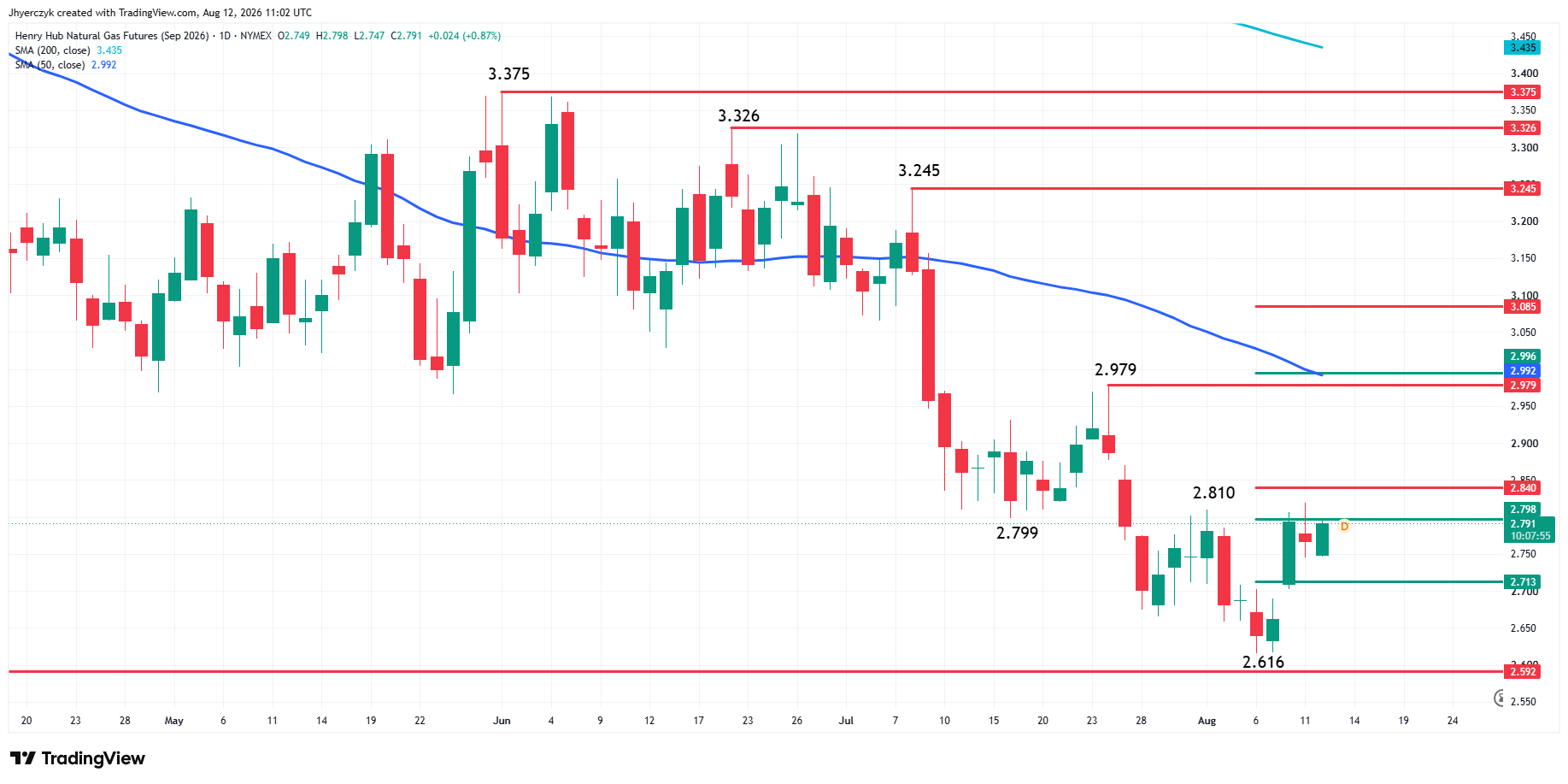
September natural gas futures are edging higher early Wednesday. Despite yesterday’s weak dip, the market is showing some resilience as it tests the lower 50% level of a key retracement zone at $2.798. Overtaking this level will indicate the buying is getting stronger.
If traders can take out $2.810, the main trend will change to up, but they could face immediate resistance at the upper Fibonacci level at $2.840. Nonetheless, given the room on the chart until the next resistance at $2.979, we’re going to call $2.840 a potential trigger point for an acceleration to the upside.
In addition to the swing top at $2.979, traders could face resistance at the 50-day moving average at $2.992 and the intermediate retracement zone at $2.996 to $3.085.
On the downside, the key support is a short-term 50% level at $2.713.
Natural Gas Price Forecast
Every new Natural Gas analysis as it publishes, today's technical signal and key levels, live price — on one page.
See all Natural Gas forecastsHeat Is Keeping the Bid Alive but Storage Keeps Rejecting It
Natural gas moved higher early Tuesday on a hotter forecast before giving it all back by the close. Above-normal temperatures across the South from August 16 through August 20 with highs running from the upper 80s to low 110s are pushing air-conditioning load and gas burn at power plants higher. The southern two-thirds of the country stays hot through the weekend in the 90s and 100s while the northern United States cools into the 70s and 80s.
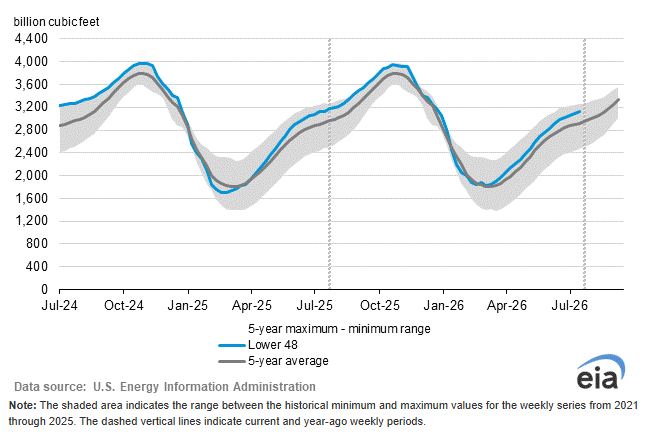
That is strong short-term demand but it is not overcoming the storage surplus. Last week’s injection came in at 33 Bcf against a 30 Bcf estimate and a five-year average build of 23 Bcf. The weather was already warm when that number printed, and storage still built faster than expected. Electricity output rose 0.9% year-over-year in the week ending August 1 with the 52-week total up 2.1%. The power market is consuming more, just not enough to change the injection pace with production running where it is.
Production Keeps Climbing and More Permian Gas Arrives in September
Lower-48 dry gas output hit 112.0 Bcf per day Tuesday, up 2.3% year-over-year, and the EIA does not see it slowing down. The agency expects 111.2 Bcf per day this year and 116.0 Bcf per day in 2027. Demand is forecast at 92.0 Bcf per day, actually trimmed from last month’s estimate, while the production number stayed the same. That is the EIA telling you the gap between supply and consumption is widening, not closing. The rig count dropped three to 124 last week and it made no difference. Production did not flinch.
LNG feedgas slipped to 17.6 Bcf per day Tuesday while export facilities work through maintenance. European storage sitting at 59% against a five-year average of 76% should be pulling harder on U.S. cargoes, but the export demand is not strong enough right now to keep pace with what production is putting into the system.
The timing gets worse for buyers on September 1. Energy Transfer expects the Hugh Brinson pipeline to hit its full 1.5 Bcf-per-day capacity, sending more Permian gas straight to Henry Hub just as summer cooling demand starts to fade and before winter heating picks up. More supply arriving during the shoulder season is not what this market needs with storage already heading toward a 10-year high.
What to Watch
The EIA’s October storage forecast changed the trade this week. The market was bouncing on heat and short-covering. Now it has a projection showing nearly 4 Tcf in storage before winter with production at 112 Bcf per day. Additionally, LNG feedgas is running below where it needs to be. Hugh Brinson adds 1.5 Bcf per day of Permian supply in September right when cooling demand fades. The rally needs smaller builds, stronger exports and a production pullback to hold, and none of those showed up this week.
The main trend is still down and the pattern of lower highs has not been broken. The contract is testing the lower boundary of the retracement zone, which is where this bounce either proves itself or fails. The swing top at $2.810 changes the trend. The 50-day moving average at $2.992 sits right above it. Buyers have to clear both before this rally is anything more than another short-covering bounce that sellers fade heading into fall.
More Information in our Economic Calendar.