
Natural Gas Slips Ahead of the EIA Report That Decides Whether Heat Matters
September natural gas pulled back Thursday ahead of the one number that determines whether the weather trade has legs or runs straight into the storage wall again. The contract rallied Wednesday on hotter forecasts. It is giving that back this morning because the market already knows what happened last time temperatures were elevated and the EIA still printed a build above expectations. The retracement zone that has capped this market for four straight sessions is still holding, and buyers have not been able to sustain momentum above it.
At 10:40 GMT, September natural gas futures were trading at $2.784, down $0.020 or 0.71%. The contract settled Wednesday at $2.787, up $0.037 or 1.34%.

Daily September Natural Gas Technical Analysis
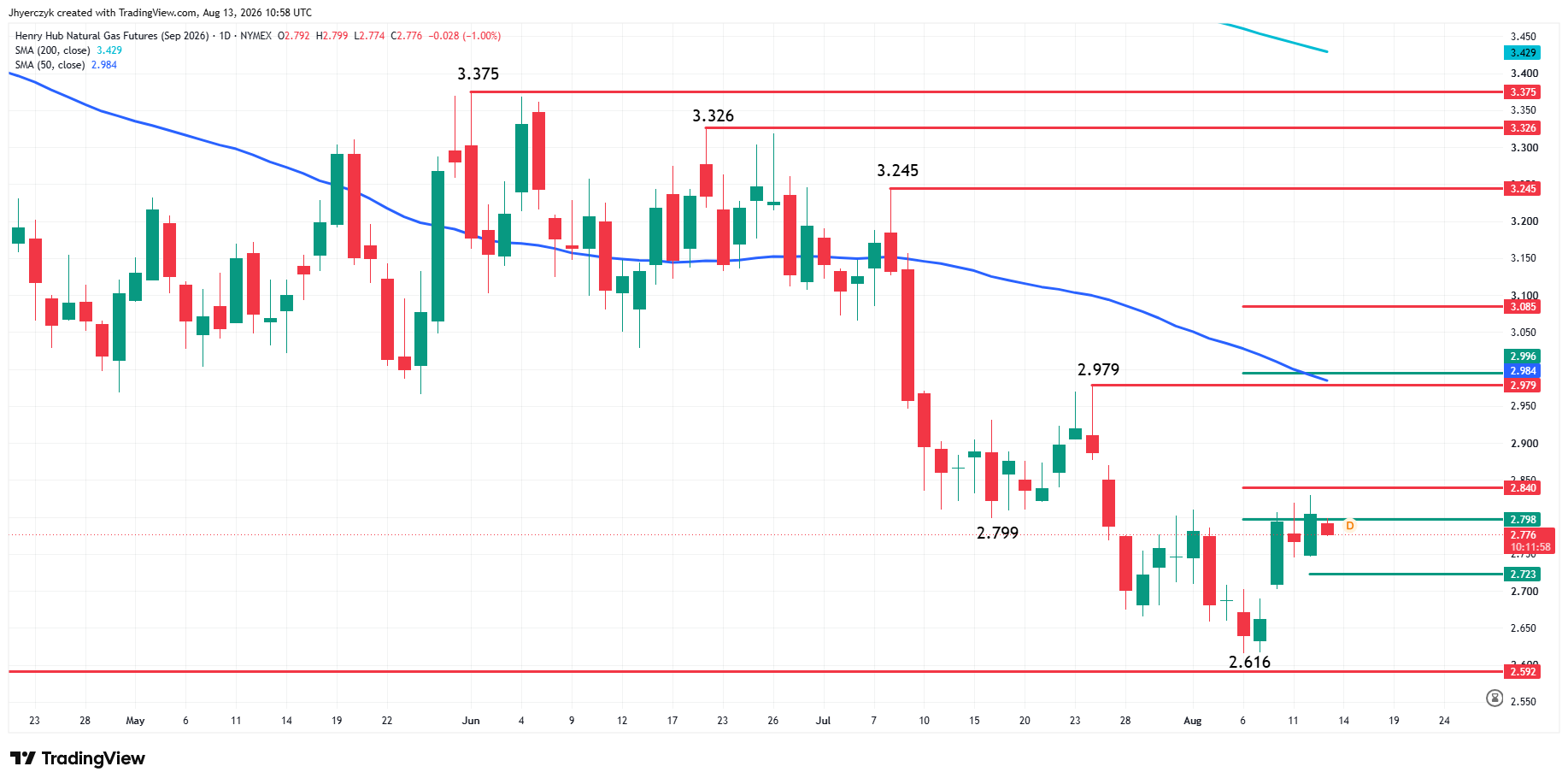
September natural gas futures are edging lower on Thursday after posting its highest price at $2.830 since July 27. The rally took out the August 3 main top at $2.810, but buyers couldn’t sustain the momentum. This typically indicates short-covering or buy stops fueled the move to $2.830.
The main range is $2.979 to $2.616. Its 50% to 61.8% retracement zone at $2.798 to $2.840 has stopped the market for four straight days. It looks as if buyers are going to have to take out $2.840 to convince new buyers to extend the rally into $2.979 or the 50-day moving average at $2.984. Additional resistance is the intermediate retracement zone at $2.996 to $3.085.
The new short-term range is $2.616 to $2.830. A failure to overcome resistance could drive the market into its 50% level at $2.723.
Heat Is Strong but Last Week’s Build Already Proved It Is Not Strong Enough
Most of the country stays hot through next week with the South running in the 90s and 100s and highs reaching 110 degrees in parts of the region. Vaisala expects hotter-than-average temperatures in the Midwest and South from August 17 through August 21 and above-normal readings in the West from August 22 through August 26. Electricity output jumped 7.0% year-over-year in the week ending August 8 to 99,864 GWh, and the 52-week total is running 2.3% above last year.
Natural Gas Price Forecast
Every new Natural Gas analysis as it publishes, today's technical signal and key levels, live price — on one page.
See all Natural Gas forecasts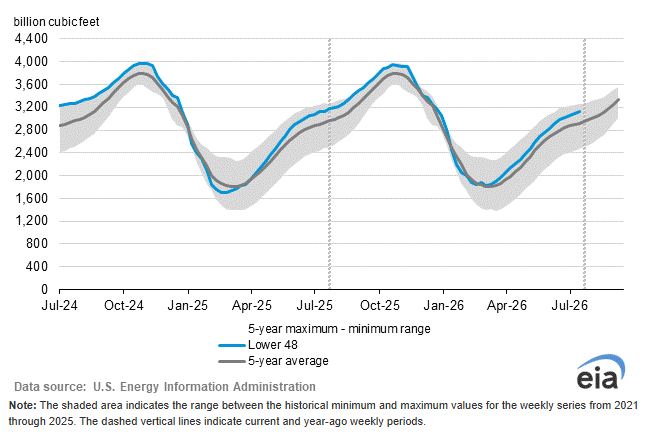
The power market is burning more gas. The question Thursday’s EIA report answers is whether it is burning enough. The market expects a 31 Bcf build for the week ending August 7. Last week’s injection came in at 33 Bcf against a 30 Bcf estimate and a five-year average of 23 Bcf with warm weather already in place. Storage sits 6.7% above the five-year seasonal average and the EIA projects it reaching 3,985 Bcf by the end of October, the highest in 10 years.
The calendar is working against buyers. September is three weeks away and cooling demand starts fading before winter heating picks up. A hot forecast can trigger buying. It does not settle the market unless the storage numbers start tightening, and they have not tightened yet.
Production Keeps Climbing and LNG Maintenance Leaves More Gas at Home
Lower-48 dry gas production reached 112.7 Bcf per day Wednesday, up 3.2% year-over-year, while demand ran 82.2 Bcf per day, down 3.1%. The rig count dropped three to 124 last week and it has not slowed output. The EIA cut its Henry Hub spot price forecast to $2.87 per million British thermal units for the third quarter, down $0.50 from the prior outlook, tying the reduction directly to strong production and reduced LNG demand.
LNG feedgas slipped to 18.3 Bcf per day Wednesday, down 1.4% from the prior week. Freeport LNG maintenance is pulling export demand lower and leaving more gas in the South Central storage region. The EIA expects third-quarter LNG exports to average 16.5 Bcf per day, below its July forecast, and that is a key reason it sees October inventories climbing toward 4 Tcf.
European storage at 59% against a five-year average of 76% should eventually pull harder on U.S. cargoes once maintenance ends. That is a later trade. The current trade is lower feedgas, record production and a storage outlook that gets heavier every time the EIA updates it.
Energy Transfer expects the Hugh Brinson pipeline to reach full 1.5 Bcf-per-day capacity on September 1, routing more Permian gas to Henry Hub during the shoulder season when utilities have the least reason to burn.
What to Watch
Thursday’s storage report lands with the market already telling you it does not believe the heat alone changes anything. Production above 112 Bcf per day, LNG feedgas running below forecast and the Hugh Brinson pipeline three weeks from full capacity all favor sellers heading into fall. The EIA’s number either confirms that or gives buyers their first real reason to fight back. Last week’s build came in above expectations with warm weather already in place. The market remembers.
The retracement zone between $2.798 and $2.840 has rejected four straight rallies. The 50-day moving average sits just above the top of that zone. Buyers have to clear both to shift the trend, and they have not been able to hold even the first level. Until the storage data starts tightening, that zone is a ceiling and every push into it is a chance for sellers to reload.
More Information in our Economic Calendar.