
Texas Heat Reversed Monday’s Break but the Supply Side Has Not Changed
Nymex Natural Gas snapped back Tuesday after hotter weather models put prolonged heat back across the South and West through the end of August. Monday’s gap lower came on cooler forecasts for the Midwest and Northeast. The new models pushed back on that trade hard enough to recover nearly the entire prior session’s loss. Shorts covered and buyers stepped in, but the rally is running into 111.6 Bcf per day of production and a storage surplus that has not tightened despite weeks of summer heat that was supposed to do the job. The 50-day moving average is still a long way overhead and Tuesday’s move is a bounce, not a breakout.
The contract reached $2.778 during the session after trading as low as $2.692. The recovery took out Monday’s retracement zone resistance and reclaimed the ground that the gap lower surrendered on the opening.
At 18:45 GMT on August 18, September natural gas futures were trading at $2.774 per million British thermal units, up $0.084 or 3.12%.

Record Output and Freeport Maintenance Are Still Capping Every Rally
Lower-48 dry gas output has averaged about 111.6 Bcf per day in August, above July’s record monthly average of 110.7 Bcf per day. Producers have not flinched at lower prices. Associated gas from Permian oil drilling keeps adding supply whether the gas market wants it or not. Oil producers do not stop drilling because natural gas prices soften. The gas comes with the oil. Haynesville production is also running full. The gas keeps showing up regardless of what the weather is doing.
Freeport LNG maintenance has kept roughly 2 Bcf per day of export capacity offline since July. That gas has stayed in the domestic market at the worst possible time, piling into storage during the weeks when summer demand was supposed to be drawing the surplus down. Feedgas deliveries to the nine major U.S. LNG plants have averaged about 17.3 Bcf per day this month, slightly above July and close to the June record. Freeport is the missing piece. The maintenance is expected to wrap up later this month. Tuesday’s rally priced the heat, not the export recovery, and that recovery has not started yet.
The Heat Has to Show Up in Thursday’s EIA Weekly Natural Gas Storage Report
Houston is expected to average near 100 degrees Fahrenheit from August 20 through August 23, about five degrees above normal. The Texas power grid could set another demand record if the heat holds and wind generation drops during peak hours. Monday’s cooler models had the market thinking cooling demand was fading into the shoulder season. Tuesday’s models changed that view overnight.
Working gas in storage sat at about 3,153 Bcf as of August 7, roughly 6% to 7% above the five-year seasonal average. The surplus grew through the hottest stretch of the summer. Thursday’s EIA weekly natural gas storage report covers the week ending August 14. Early estimates point to an injection near 14 Bcf, below the five-year average and below last year’s build for the same period. That would be the first storage number that actually reflects what the heat has been doing. Every previous report came in heavy regardless of the temperature, and Tuesday’s rally needs Thursday to confirm it.
Natural Gas Price Forecast
Every new Natural Gas analysis as it publishes, today's technical signal and key levels, live price — on one page.
See all Natural Gas forecastsDaily September Natural Gas Futures Technical Analysis
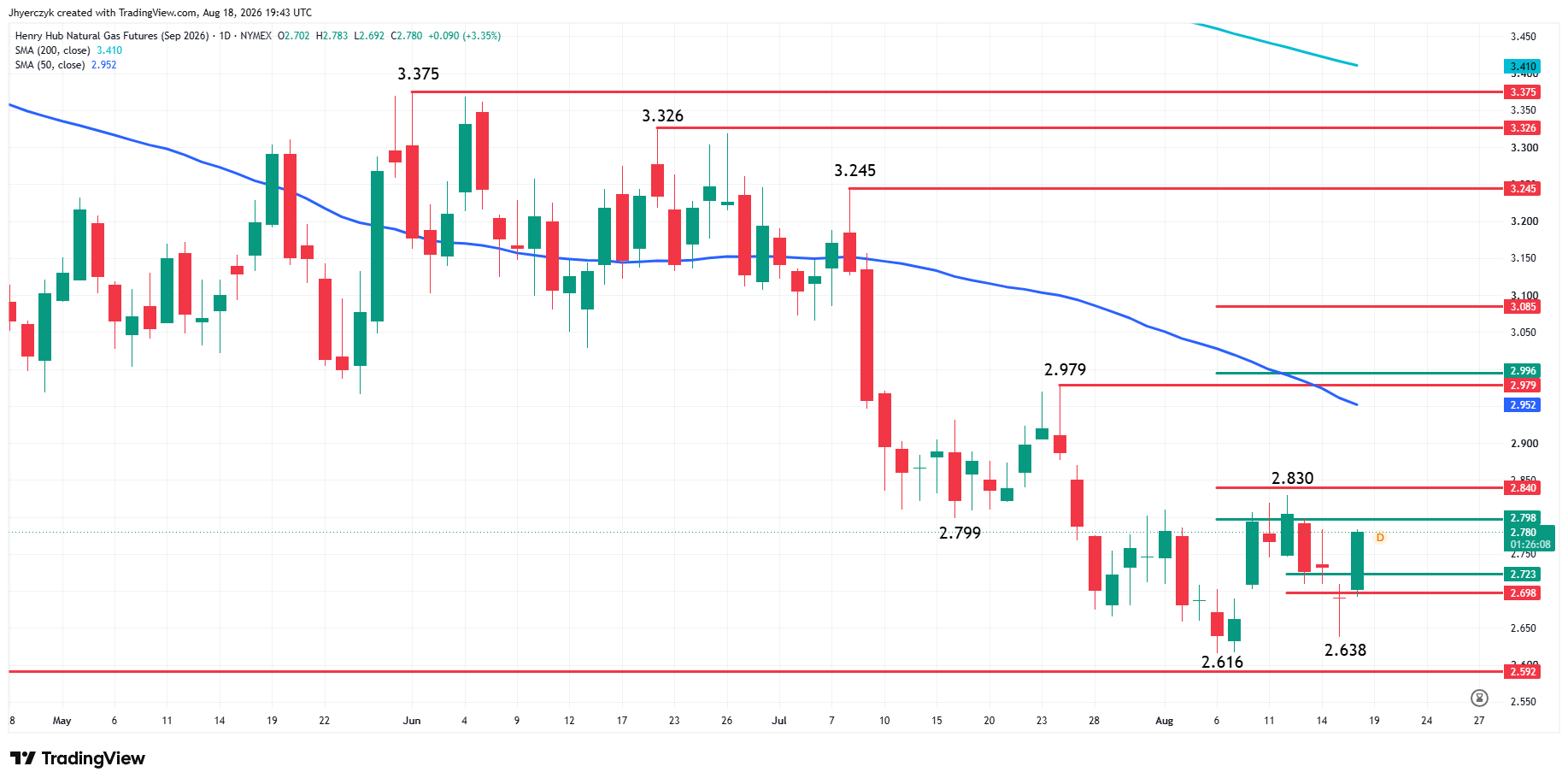
September Natural Gas futures are in a position to close sharply higher on Tuesday after recovering from Monday’s gap-lower opening and taking out minor retracement zone resistance at $2.698 and $2.723. If traders can build a support base on the strong side of this retracement zone, there’s a chance momentum could shift enough to overtake the next retracement zone resistance at $2.798 to $2.840, including the main swing top at $2.830.
A surge through $2.840 will indicate the buying is getting stronger. This could extend the rally into the 50-day moving average at $2.952.
On the downside, a trade back under $2.698 will be a sign of weakness with $2.638 to $2.616 the next target zone.
What to Watch
Thursday’s EIA weekly natural gas storage report carries all the weight. An injection near 14 Bcf tells the market the heat is finally reaching the data. Another build above expectations hands it right back to sellers sitting on record production and a growing surplus.
The weather models are fragile. Monday gapped the market lower on a cooler revision. Tuesday took it back on a hotter one. The swing top at $2.830 has to break before the 50-day moving average at $2.952 comes into play. Freeport coming back later this month alongside sustained heat would give buyers their strongest case all summer. Neither one has arrived yet.
More Information in our Economic Calendar.