
Texas Heat Pushed Natural Gas Through Resistance and Changed the Trend
Nymex Natural Gas surged Wednesday after updated forecasts put prolonged heat across the South and West through late August and into early September. The rally was not a one-session bounce. The market broke through resistance, changed the main trend to up for the first time in weeks and kept running until it stalled just short of the key moving average overhead. Houston is expected to average near 100 degrees Fahrenheit from August 20 through August 23 and ERCOT could set a new peak demand record if the heat holds and wind generation drops during peak hours.
Production dipped slightly from the August highs on the same day the weather models turned hotter. That combination brought buyers in fast and caught the short side of the market leaning too hard into a trade that had been working for weeks.
At 17:00 GMT, September natural gas futures were trading at $2.837, up $0.061 or 2.20%.

Production Dipped and the Weather Turned Hotter on the Same Day
Lower-48 dry gas output has averaged roughly 111.5 to 111.6 Bcf per day in August, above July’s record. That has been the ceiling over every rally attempt this summer. Wednesday’s data showed a modest pullback in daily production. The decline was not large. The timing was.
A small dip in output while temperatures are rising across the South and West tightens the near-term balance faster than either factor would alone. Producers have been putting enough gas into the system to absorb summer power demand for months. Wednesday was the first session where the production number and the weather forecast moved in the same direction at the same time.
Associated gas from Permian oil drilling has been a persistent source of supply pressure all summer. Oil producers do not adjust drilling plans based on gas prices. The gas comes with the oil. Haynesville production has also stayed full. Wednesday’s dip was notable because it came from a system that has not shown any willingness to slow down.
LNG feedgas deliveries to the nine major U.S. export terminals have held near 17.2 to 17.7 Bcf per day, close to recent record levels. Middle East tensions have limited LNG shipping through the Strait of Hormuz, pushing European and Asian buyers toward U.S. supply. Every molecule moving into an export terminal is not available for domestic storage. Strong exports, a production dip and rising heat demand all hit the market on the same session.
Natural Gas Price Forecast
Every new Natural Gas analysis as it publishes, today's technical signal and key levels, live price — on one page.
See all Natural Gas forecastsThursday’s EIA Report Is the First Hard Test of the Rally
Working gas in storage remains above the five-year seasonal average after a spring of mild weather and strong production allowed supplies to build. That surplus has been the bears’ argument every time the weather turned hot and the rally stalled.
Thursday’s EIA report covers a period when temperatures were already elevated across the South. Early estimates point to a smaller-than-average injection. A light build would confirm that heat is finally pulling enough gas into the power sector to slow the pace of storage gains. The last several reports came in above expectations despite warm temperatures. The market has been waiting for a number that matches what the thermometer has been showing.
The storage surplus is still there. The calendar is still turning toward the shoulder season. Wednesday’s rally changed the trend and broke through resistance, but the major moving average overhead has not been tested yet. That is the level that separates a weather bounce from a move that forces the bears to rethink the trade entirely.
Daily September Natural Gas Futures Technical Analysis
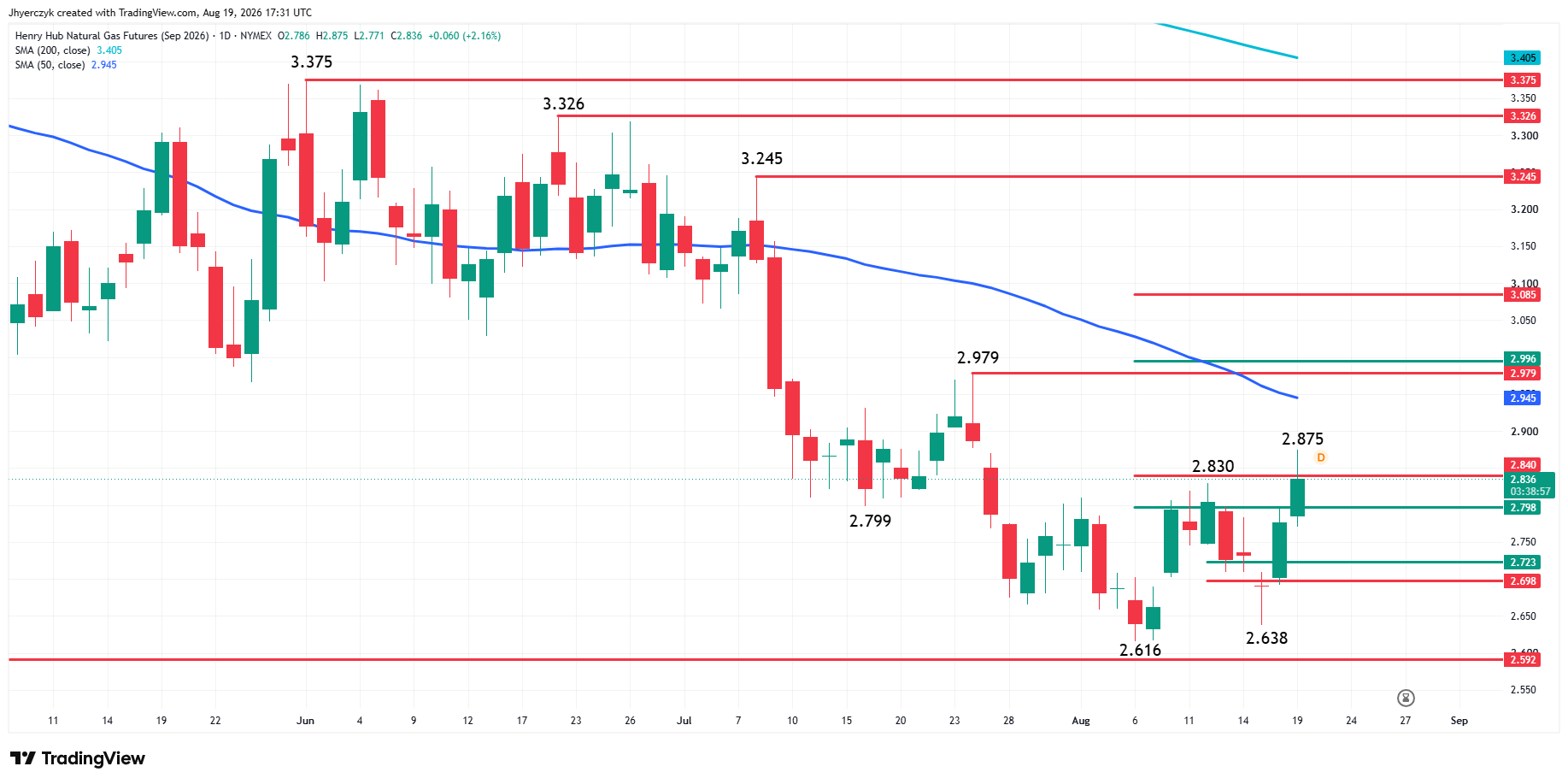
September natural gas futures are sharply higher late Wednesday after surging through resistance earlier in the session. The rally started when buyers overtook a key 50% level at $2.790. The main trend changed to up when the swing top at $2.830 was taken out and the market accelerated to the upside on the breakout above the Fibonacci resistance at $2.840.
The strong move stalled at $2.875, just short of the 50-day moving average at $2.945. This is the major resistance and trend indicator. Overtake this indicator and the rally is likely to extend into the long-term retracement zone at $2.996 to $3.085.
Traders should note that rallies in the summer are different than rallies in the winter. Summer rallies are much shorter in price and duration, so be prepared to hit and run because short-sellers can jump back in quickly.
What to Watch
Thursday’s storage report decides whether Wednesday’s trend change holds. A below-average injection confirms the heat is reaching the data. Another heavy build hands the argument back to sellers who still have record production and a surplus on their side. ERCOT demand over the next several days will show whether Texas heat is strong enough to keep gas burn elevated through the end of August.
The main trend changed to up on Wednesday for the first time in weeks. The 50-day moving average at $2.945 is the next resistance and the rally stalled just short of it at $2.875. Production dipped, LNG exports are running near record levels and the weather models have extended the heat. The bears still have storage above the five-year average. Thursday’s number tells the market which side has the stronger case heading into the final stretch of summer.
More Information in our Economic Calendar.