
Everything on the supply side says crude prices should be coming down. Tankers are loading in the Gulf again. The Saudis restarted their pipeline, while American producers just pumped more oil than they ever have. So why is the premium still sitting there? Go look at diesel. Storage is getting drained, gasoline is going with it and Hormuz traffic is a long way from what traders used to see.

WTI Gave a Little Back Overnight
November WTI crude oil futures are a touch softer in the overnight session. December Brent crude oil futures did the work Wednesday, rallying into the settlement, and WTI hasn’t followed through overnight. It’s parked inside its first retracement support zone, not far off Wednesday’s low. December Brent crude oil hasn’t traded since the settlement, so Wednesday’s close is the last real print on it. The overnight range is barely more than a dollar wide. Nobody’s pressing it in either direction yet.
At 23:50 GMT, November WTI crude oil futures are trading at $89.93, down $0.49 or -0.54%. The contract traded from $89.33 to $90.51. December Brent crude oil futures settled Wednesday at $98.03, up $1.87 or +1.94%.
Diesel Is Where the Premium Lives
The crude build barely registered. Inventories rose 922,000 barrels to 427.3 million against the 264,000-barrel draw the street expected. I’ll take a distillate draw over a crude build every time I’m deciding which number matters. Diesel and heating oil stocks fell 2.3 million barrels to 105.2 million, with gasoline down 1.7 million barrels to 204.4 million. One week of draws doesn’t make a shortage, but with freight still expensive, it was enough to keep the premium in place.
Refiners are already running hard for the margins. Utilization averaged 96.3% in the third quarter, up from 94.7% a year earlier, and diesel demand plus shipping constraints still kept the system tight.
Brent Oil Price Forecast
Every new Brent Oil analysis as it publishes, today's technical signal and key levels, live price — on one page.
See all Brent Oil forecastsWashington’s moves back that up. The White House is urging the European Union to consider drawing emergency diesel inventories. It’s also weighing broader red-dyed diesel sales as an alternative to a diesel export ban.
The Gulf Is Shipping Again With No Deal Signed
Gulf barrels coming back is the real bearish story here, and the sellers are right to press it. Goldman Sachs put exports at 23.3 million barrels per day over the past week, right around the 2025 average. JPMorgan’s 10-day read is lower at 20.5 million, about 89% of normal. JPMorgan’s is the one to lean on. One good week after a disruption like that doesn’t prove the flows are going to stick.
Saudi Arabia has Yanbu loading tankers again off the restarted East-West Pipeline. Those barrels are a big part of why neither benchmark is anywhere close to its September highs.
Nothing’s signed, though. U.S. and Iranian officials are still going through mediators. President Trump denied reports that he offered sanctions relief or freed up frozen funds for Iranian nuclear concessions. Flows that came back with the conflict still open can disappear just as fast. A threat to Hormuz traffic, Saudi infrastructure or regional shipping can still force shorts to cover in a hurry.
U.S. Producers Set a Record and Still Don’t Trust Price
Record U.S. production is the best card the sellers hold. The Energy Information Administration had output at 13.955 million barrels per day for the week ended September 25. Put that next to the Gulf numbers and it’s hard to see a rally running away from here.
The producers don’t sound sold on these prices themselves. The Dallas Fed survey had oil and gas activity picking up in the third quarter. More activity on top of record output isn’t what anybody long wants to hear. Exploration and production firms are still uneasy about the volatility, though.
Their year-end WTI calls average near $88, from as low as $70 to as high as $126. The bottom of that range sits nearly $20 under where WTI is trading overnight. When the people drilling the wells are $56 apart, a settled supply picture isn’t something to bet on. They’re pumping a record anyway.
Daily November WTI Crude Oil Futures Technical Analysis
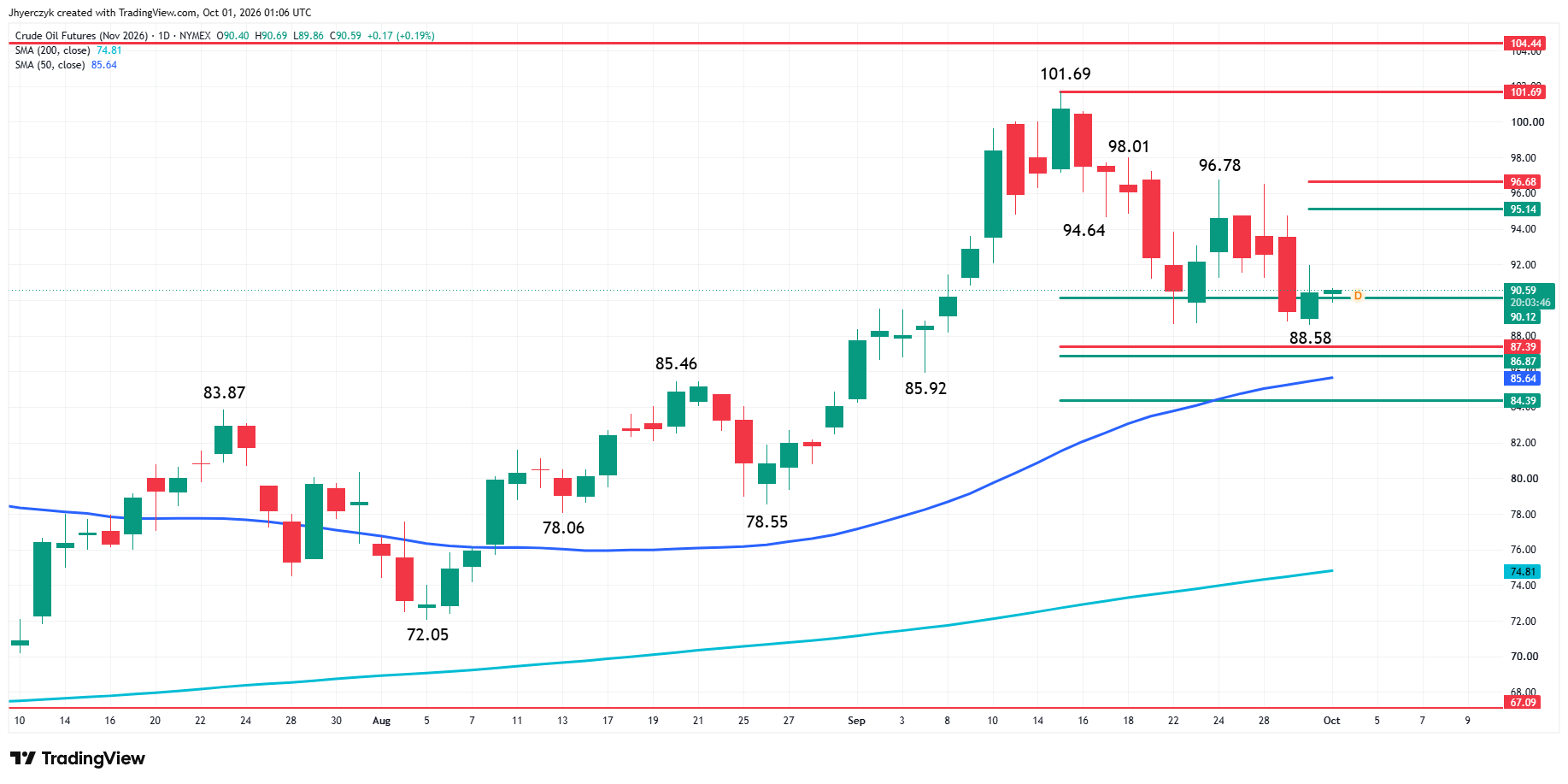
November WTI crude oil futures are putting in a mixed performance early Thursday. The main trend is up according to the daily swing chart, however, the lower top at $96.78 shows sellers came in before the market could make another run at $101.69. Taking out $101.69 will signal a resumption of the uptrend. A trade through $78.55 will change the main trend to down.
Retracement zone support is $90.12 to $87.39, followed by a 50% level at $86.87, the 50-day moving average at $85.62 and a second 50% level at $84.39.
A sustained move over $90.12 could bring in buyers and put $95.14 to $96.68 back in play.
Daily December Brent Crude Oil Futures Technical Analysis
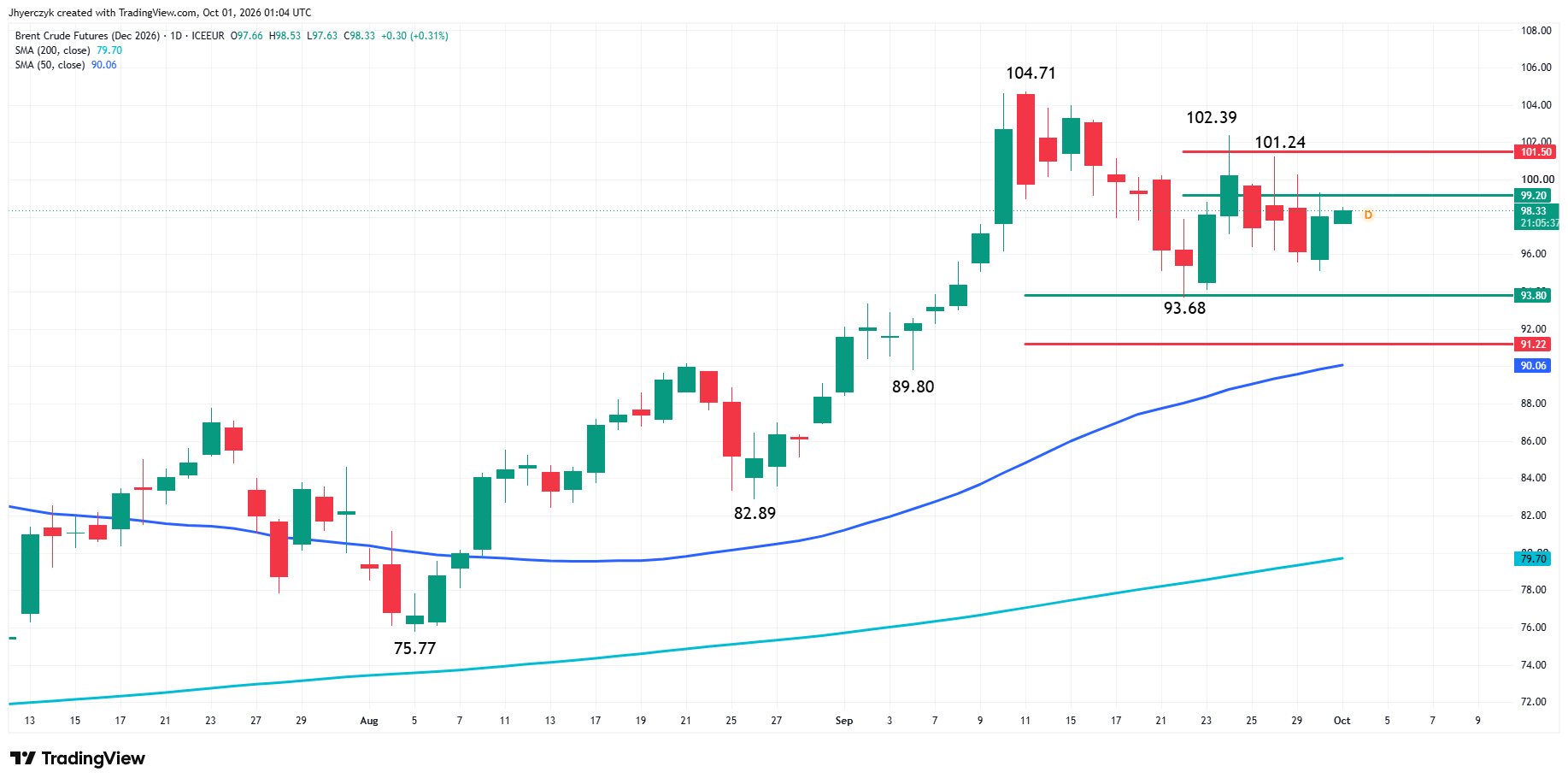
December Brent crude oil futures settled higher Wednesday after an impressive reversal from early weakness.
The main trend is up according to the daily swing chart, however, momentum has been trending lower since the formation of the closing price reversal top on September 11 at $104.71. A new lower top has formed at $102.39. A trade through this level will put $104.71 back in play. The main trend will change to down on a move through $93.68.
The nearest resistance is $99.20 to $101.50. A sustained move over $101.50 would indicate the presence of buyers.
On the downside, support is $93.80 to $91.22, followed by the 50-day moving average at $90.06.
What to Watch
OPEC+ meets Sunday. Sources don’t expect any change to November production targets, which hands the weekend back to the headlines. The next oil headline is going to move this market more than any inventory number can.
Hormuz is the one that can override everything else. Traffic is improving without being normal, and the talks are still running through mediators with nothing on paper.
Diesel policy is the other open file. Washington hasn’t made the call on broader red-dyed diesel sales, and the White House request to the European Union on emergency diesel stocks is still out there.
WTI is sitting inside its first support zone, with trader reaction to the 50% level at $90.12 likely to determine the direction on Thursday. Brent settled under resistance, leaving trader reaction to $99.20 to $101.50 as the key area to watch.
If you’d like to know more about how to trade crude oil, please visit our educational area.