
The Gold & Silver Club believes the greatest opportunities may still lie ahead.
Beyond precious metals, another Commodity story is unfolding: the rising cost of securing, transporting and replacing the resources on which the global economy depends.
For decades, the global economy operated on one reassuring assumption: there would always be more.
More Oil. More Metals. More crops. More production. More supply.
That assumption is fracturing.
For The Gold & Silver Club, the opportunity may lie not simply in identifying which market rises next, but in recognizing a fundamental shift in how essential assets are valued.
What if 2026 is not the peak of the Commodity boom, but the opening chapter of The Hard Asset Decade?

The Great Commodity Repricing
According to GSC Commodity Intelligence’s October market snapshot, European Natural Gas has surged 189% year-to-date, Heating Oil around 119% and Gasoline more than 90%.
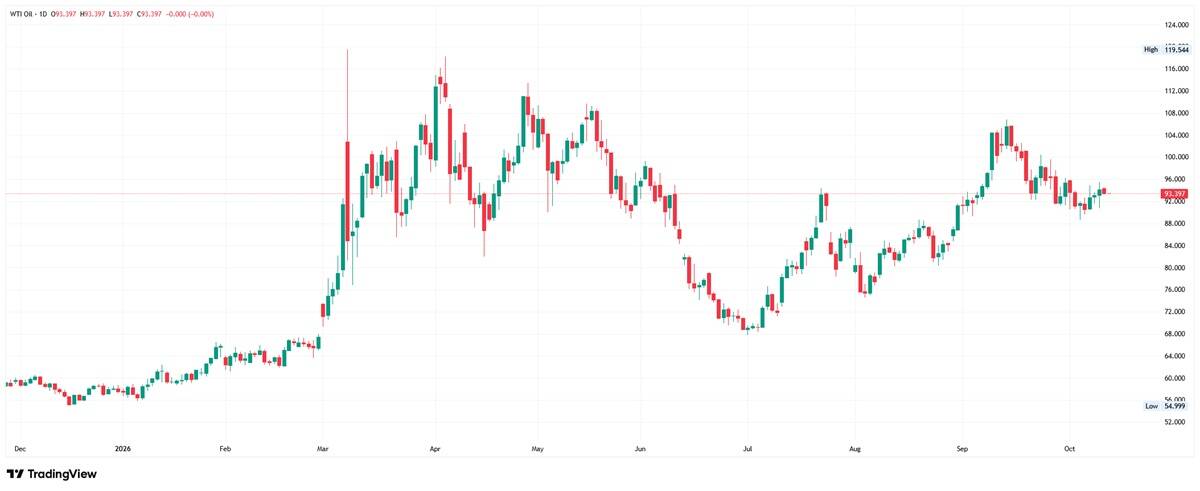
Brent has advanced 72%, while WTI has gained 60%. Agriculture is also participating – Wheat has risen 32%, Soybeans 25%, Cotton 24% and Corn 19%.
For The Gold & Silver Club, the significance extends beyond individual price rallies. It is the simultaneous repricing of essential resources and the infrastructure required to keep them moving – that strengthens the case for The Hard Asset Decade.
“What makes 2026 so important is the breadth of the move,” says Lars Hansen, Head of Research at The Gold & Silver Club. “Scarcity premiums are appearing simultaneously across Energy, Agriculture, Metals and Critical Materials. That is the hallmark of a broader regime change.”
Brent Oil Price Forecast
Every new Brent Oil analysis as it publishes, today's technical signal and key levels, live price — on one page.
See all Brent Oil forecastsThe Rising Cost of Securing Physical Oil
The distinction between a benchmark quotation and the cost of securing delivered supply is becoming increasingly consequential.
On October 6, Chevron’s chief executive said the landed price of physical Oil in Asia was closer to $150 a barrel than $100, highlighting pressure on delivered supplies.
For buyers, the relevant price is not simply the number on a trading screen. It is the full cost of getting a usable cargo to its destination.
“When physical Oil commands such extraordinary premiums, traders should pay close attention,” Hansen says. “It suggests immediate access to supply is becoming exceptionally valuable.”
The Financial Times has also reported Vitol’s warning about tanker shortages and the risk of $200 a barrel Oil. That is an upside risk scenario, not an inevitable destination.
The Oil Market Has Discovered a New Kind of Shortage
The availability of barrels is only part of the supply equation. The capacity to move them can be just as consequential.
According to GSC Commodity Intelligence’s October report, Middle East-to-Asia supertanker rates reached approximately $1.4 million per day, compared with roughly $30,000 in January.
That is nearly 47 times as much.
On another major route, transporting Oil from the United States to China has reached $80 million per voyage, exceeding the advertised $74 million price of launching a SpaceX Falcon 9 rocket.
This is not merely an expensive shipping market. It illustrates how bottlenecks in essential infrastructure can transform the economics of an entire Commodity.
“The world may have Oil, but delivering it efficiently is becoming a much bigger challenge,” Hansen says. “Scarcity is spreading from the resource itself to the infrastructure required to transport it.”
The 7,051% Gain Becoming Impossible to Ignore
The shipping squeeze is also being reflected in financial markets.
The Breakwave Tanker Shipping ETF (BWET) has surged an astonishing 7,051% over the past 12 months, according to data tracked by GSC Commodity Intelligence. For comparison, the S&P 500 has recorded a gain of 14.4%, over the same period.
To put that into perspective, a $100,000 investment in BWET made a year ago would have grown to approximately $7.15 million.
For GSC Commodity Intelligence, the significance extends beyond one fund. The Scarcity Trade encompasses not just essential resources, but the capacity to deliver them.
“Scarcity is no longer simply about what exists underground,” Hansen says. “It is about what can actually reach the consumer, in the right form, at the right time.”
Diesel Is Bringing Scarcity Into the Real Economy
The pressure is also reaching household budgets.
In its October outlook, the U.S. Energy Information Administration forecast that households using Heating Oil would spend approximately 21% more this winter than last winter.
On October 2, G7 governments agreed to release 100 million barrels of Oil and fuel reserves over four months, prioritising substantial Diesel deliveries within the first 20 days.
Reserves can provide relief. They cannot instantly repair damaged infrastructure or establish permanently higher production capacity.
“Scarcity stops being abstract when the physical product becomes difficult to source,” Hansen says. “Diesel powers trucks, farms, mines and supply chains. When Diesel reprices, the cost of moving almost everything reprices with it.”
The Hard Asset Decade: The Opportunity Beyond 2026
The Gold & Silver Club declared 2026 The Year of Hard Assets.
Its greater conviction is that the structural forces behind the Commodity boom could extend throughout the coming decade.
Energy powers industry. Agriculture depends on fuel and fertilisers. Electrification requires Copper and Silver. Artificial intelligence demands electricity and critical materials.
Governments can create liquidity. Central banks can adjust interest rates.
Neither can instantly create another barrel of Oil, tonne of Copper or functioning refinery.
The world spent decades pricing abundance. It may now be entering a decade forced to price scarcity.
That is the foundation of The Gold & Silver Club’s Hard Asset Decade thesis and the thinking behind its conviction: “None of Us Own Enough Hard Assets.”
The Year of Hard Assets may have been only the beginning.
For The Gold & Silver Club, the coming decade could present one of the greatest Commodity wealth-creation opportunities of our lifetime.
The question is not simply how much Commodities have already risen – but how much further the Scarcity Trade could run and whether you are positioned for what comes next.
Where are prices heading next? Watch The Commodity Report now, for my latest price forecasts and predictions: