


XRP extended its losing streak to five sessions on Saturday, November 15, as Canary the XRP ETF (XRPC) saw a drop in trading volume on day two. Investors continued to take profit after XRPC’s first day of trading failed to trigger a price breakout.
Fading bets on a December Fed rate cut sent the broader crypto market into a tailspin this week. BTC-spot ETF reflected market sentiment, with net outflows of $1.11 billion in the reporting week ending November 14.
XRP’s sharp reversal came despite the anticipated launch of 21Shares, Bitwise, CoinShares, and Franklin Templeton XRP-spot ETFs in the week ahead.
Canary XRP ETF Trading Volume Drops amid Crypto Market Turmoil
XRPC impressed on day one of trading, with $59 million in trading volume and net inflows of $245 million. However, volumes dropped to $26 million on Friday, November 14, weighing on the appetite for XRP on Saturday, November 15.
The broader crypto market sell-off and BTC-spot ETF outflows likely influenced institutional demand.
However, demand for XRP could soar in the week ahead, given the launch of Bitwise and Franklin Templeton’s XRP-spot ETFs.
Franklin Templeton is the largest ETF issuer launching a spot ETF, with assets under management of $43.16 billion. The ETF is expected to launch on Tuesday, November 18. Meanwhile, Bitwise has $5.7 billion in AUM, also dwarfing Canary Capital’s $71.2 million in AUM. The Bitwise XRP ETF is slated to launch between November 19 and 20.
Analysts expect Franklin Templeton and Bitwise to dominate the XRP-spot ETF market, given the absence of a BlackRock (BLK) iShares XRP Trust. Robust inflows could trigger a reversal of recent losses, potentially sending XRP toward $3.
Bitcoin Price Forecast
Every new Bitcoin analysis as it publishes, today's technical signal and key levels, live price — on one page.
See all Bitcoin forecastsUS Economic Data and the Fed in the Spotlight
The timing of XRP-spot ETF launches is everything. Fading bets on a December Fed rate cut and rising stagflation risks could dampen initial demand for XRP through ETFs.
In the week ahead, crucial US inflation and jobs data will influence risk assets. Rising consumer prices and a deteriorating labor market could weigh on demand for risk assets, such as XRP and XRP-spot ETFs.
FOMC members have recently raised concerns about elevated inflation, lowering bets on a December rate cut. According to the CME FedWatch Tool, the chances of a rate cut dropped from 66.9% on Friday, November 7, to 44.4% on Friday, November 14.
With key US economic reports in focus, traders should closely monitor FOMC member speeches. Reactions to the incoming data and views on monetary policy are likely to influence sentiment.
Technical Outlook: Key XRP Price Levels
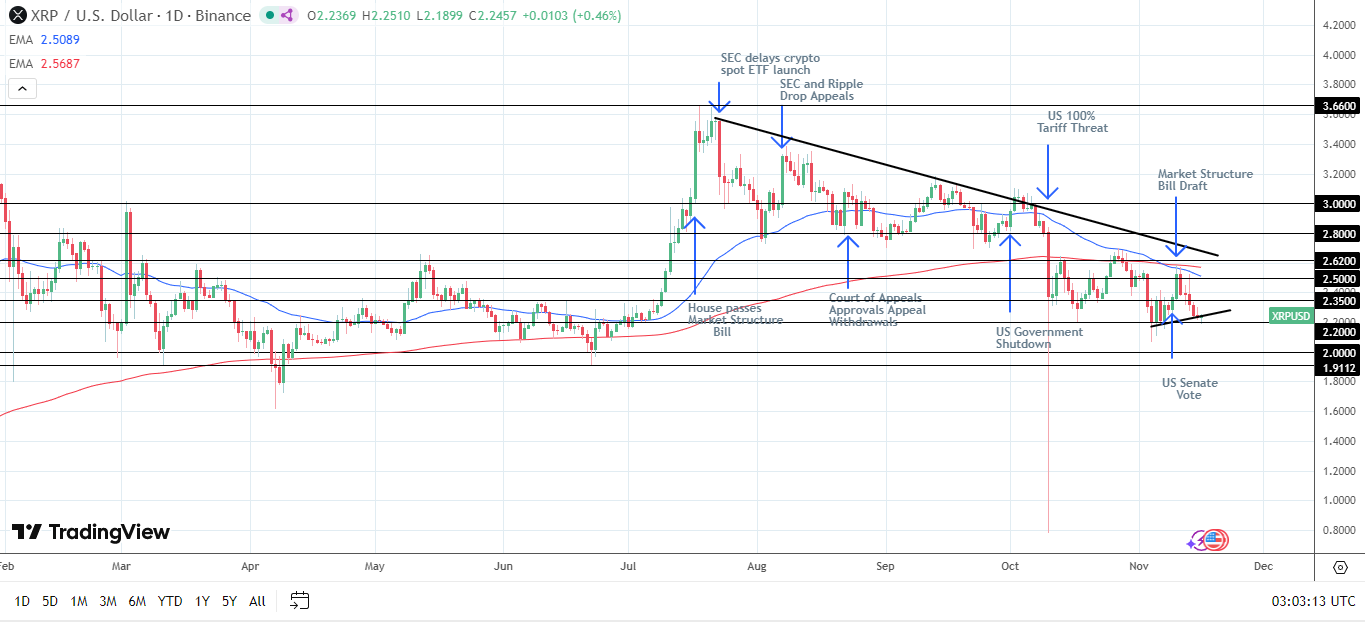
XRP fell 0.40% on Saturday, November 15, following the previous day’s 3.37% loss, closing at $2.2354. The token underperformed the broader crypto market, which rose 1.12%.
Five consecutive days of losses left XRP trading well below the 50-day and 200-day Exponential Moving Averages (EMAs), indicating bearish momentum.
Looking ahead, several scenarios could trigger a trend reversal, potentially sending XRP toward $3.
Key technical levels to watch include:
- Support levels: $2.2, $2.0, and $1.9.
- 50-day EMA resistance: $2.5089.
- 200-day EMA resistance: $2.5687.
- Resistance levels: $2.35, $2.5, $2.62, $2.8, $3.0, and $3.66.
Catalysts to Watch in the Week Ahead
In the near term, several key events will likely influence price trends:
- XRP-spot ETFs flows, Franklin Templeton and Bitwise XRP ETFs (launches or delays), and BlackRock’s position on an iShares XRP Trust.
- Blue-chip companies’ views of XRP as a treasury reserve asset.
- Regulatory milestones: Ripple’s application for a US-chartered bank license, the progress of the Market Structure Bill on Capitol Hill.
- SWIFT-related developments.
Bearish Scenario: Risks Below $2.2
- XRP-spot ETFs report net outflows.
- Franklin Templeton and Bitwise XRP-spot ETF face launch delays.
- BlackRock dismisses plans for an XRP-spot ETF.
- The US Senate challenges crypto-friendly legislation, including the Market Structure Bill.
- Blue-chip companies downplay interest in XRP as a treasury reserve asset.
- OCC delays or rejects Ripple’s US-chartered bank license.
- SWIFT maintains its market share in the global remittance sector, limiting Ripple’s market access.
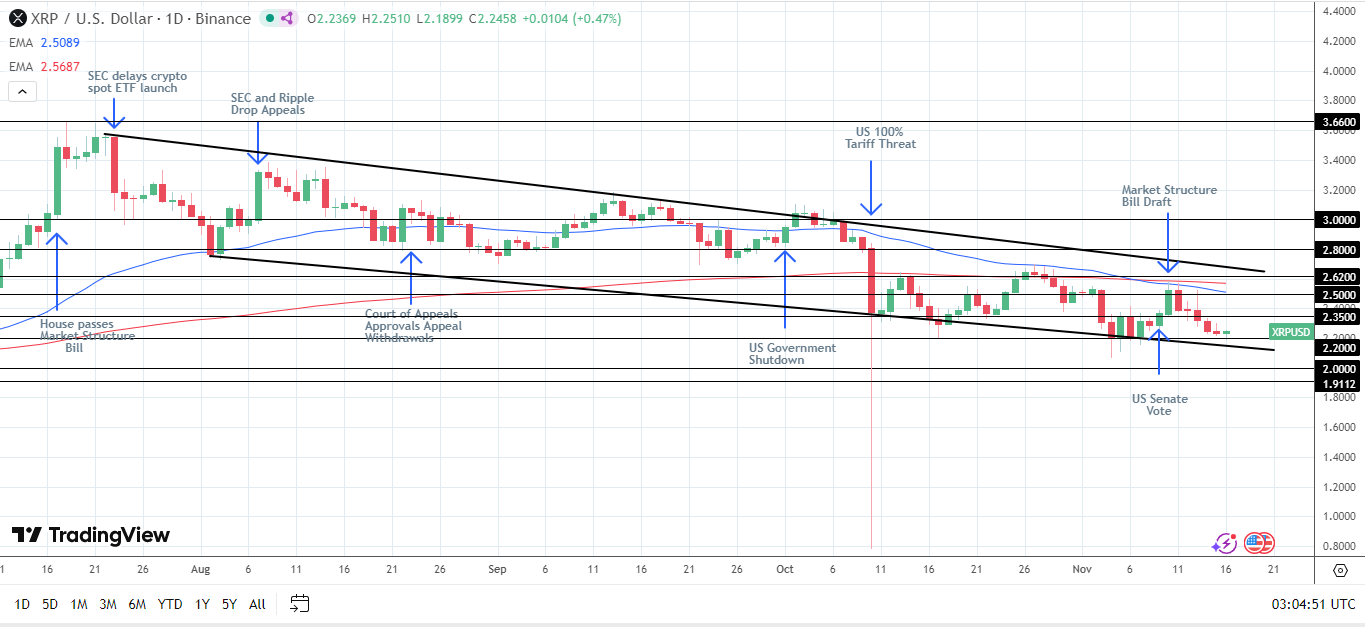
These bearish events could push XRP toward $2.2, exposing the lower trendline. If breached, $2 would be the next key support level.
The descending channel showed failed breakouts above the upper trendline in early October. This led to lower highs and lower lows, a bearish indicator. However, the lower trendline provided crucial support in early November. Support at the lower trendline remains crucial; a drop below the lower trendline could open the door to testing the $2 psychological support. See the chart below for reference.
Bullish Scenario: Path to $3 Remains Challenging
- Franklin Templeton and Bitwise launch XRP-spot ETFs.
- XRP-spot ETFs register strong inflows.
- BlackRock files an S-1 for an iShares XRP Trust.
- Blue-chip companies purchase XRP for treasury reserve purposes, and Main Street firms adopt Ripple technology.
- Ripple secures a US-chartered bank license, and the US Senate passes the Market Structure Bill.
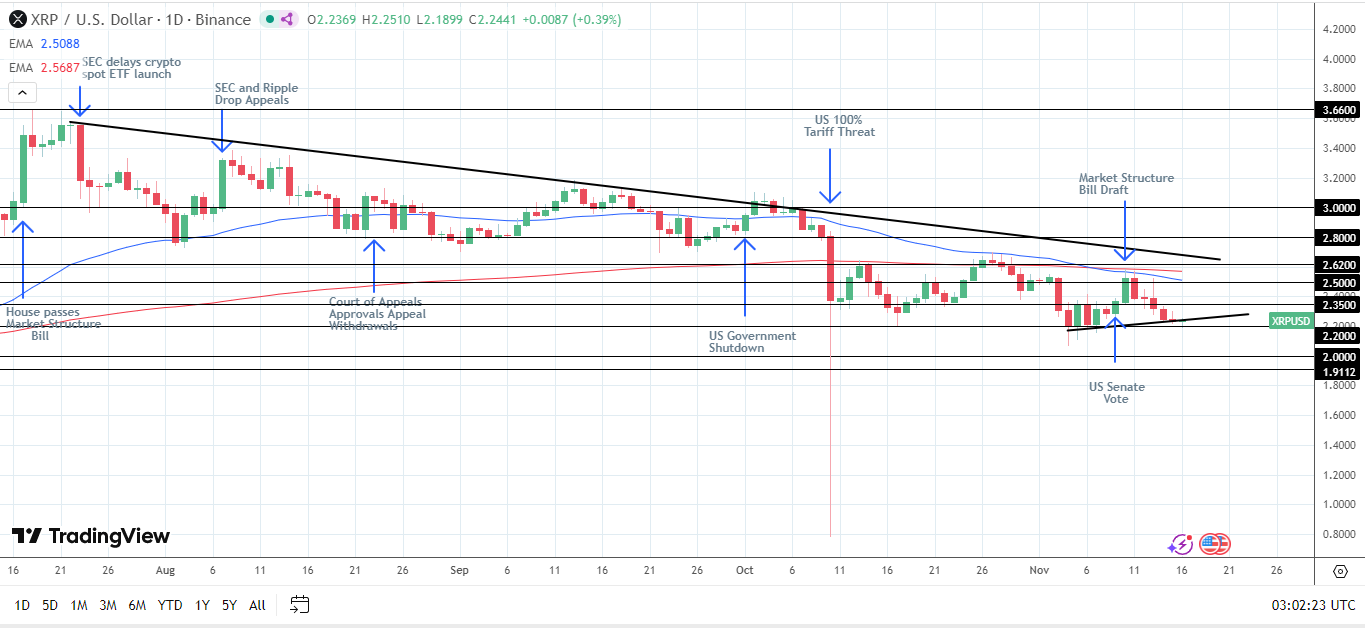
A breakout above the $2.35 resistance level could pave the way toward $2.5. A sustained move through $2.5 could bring the 50-day and 200-day EMAs into play. A break above the EMAs could open the door to testing the $2.62 resistance level, with the next key resistance level being the upper trendline.
Outlook: Near-Term Structure Signals Wider Losses
Fading bets on a December Fed rate cut and rising stagflation risks have left XRP deep in the red for the week.
However, institutional demand for spot ETFs and progress toward crypto-friendly legislation could lift sentiment.
The next 72 hours may dictate whether XRP breaks its five-day downtrend and whether the token finally decouples from Bitcoin.