


Highlights
- Gold plummets to a weekly low, impacted by anticipated high-interest rates.
- U.S. dollar ascends to a six-month apex, adversely affecting gold’s allure.
- China’s economic concerns and global growth fears buoy the U.S. dollar.
Interest Rate Expectations Pressure Gold to Weekly Low
Rising Dollar and Bond Yields
Gold (XAU/USD) prices took a dip to their lowest in a week as the U.S. dollar neared its six-month pinnacle and U.S. Treasury yields saw an upswing. These moves were spurred by expectations of persistently high-interest rates. Particularly, concerns about China and global growth, which have reduced risk appetite, have propelled the dollar to these levels, making gold pricier for holders of other currencies.
Economic Outlook and Oil Price Surge
As markets resumed after Labor Day, U.S. Treasury yields climbed, with the focal point being the economic future amidst rising oil prices due to extended supply curbs. The possibility of oil hitting the $100 mark is back on the table, causing worries on Wall Street about stocks struggling to outperform Treasuries.
Federal Reserve’s Stance
After a concerning nonfarm payrolls report and evidence of a cooling labor market, the spotlight is now on the upcoming Federal Reserve policy meeting. Despite recent data suggesting the possibility of another interest rate hike, markets anticipate that the Federal Reserve, supported by Governor Christopher Waller’s comments, might keep rates unchanged. Current market sentiment, based on the CME FedWatch tool, places a 93% bet on this steady stance.
Gold’s Diminishing Appeal Amid Global Business Slowdown
Global business activities have reportedly seen a deceleration, driving investors towards the U.S. dollar as a safer bet over gold. This shift is evident as the SPDR Gold Trust, the foremost gold-backed exchange-traded fund, witnessed a 0.1% decline in its holdings.
Short-term Forecast: Bearish
The combination of rising U.S. interest rates and Treasury bond yields has increased the opportunity cost of holding non-yielding gold. Coupled with the strengthened dollar and anticipated policy decisions, the outlook for gold remains bearish in the near term.
Technical Analysis
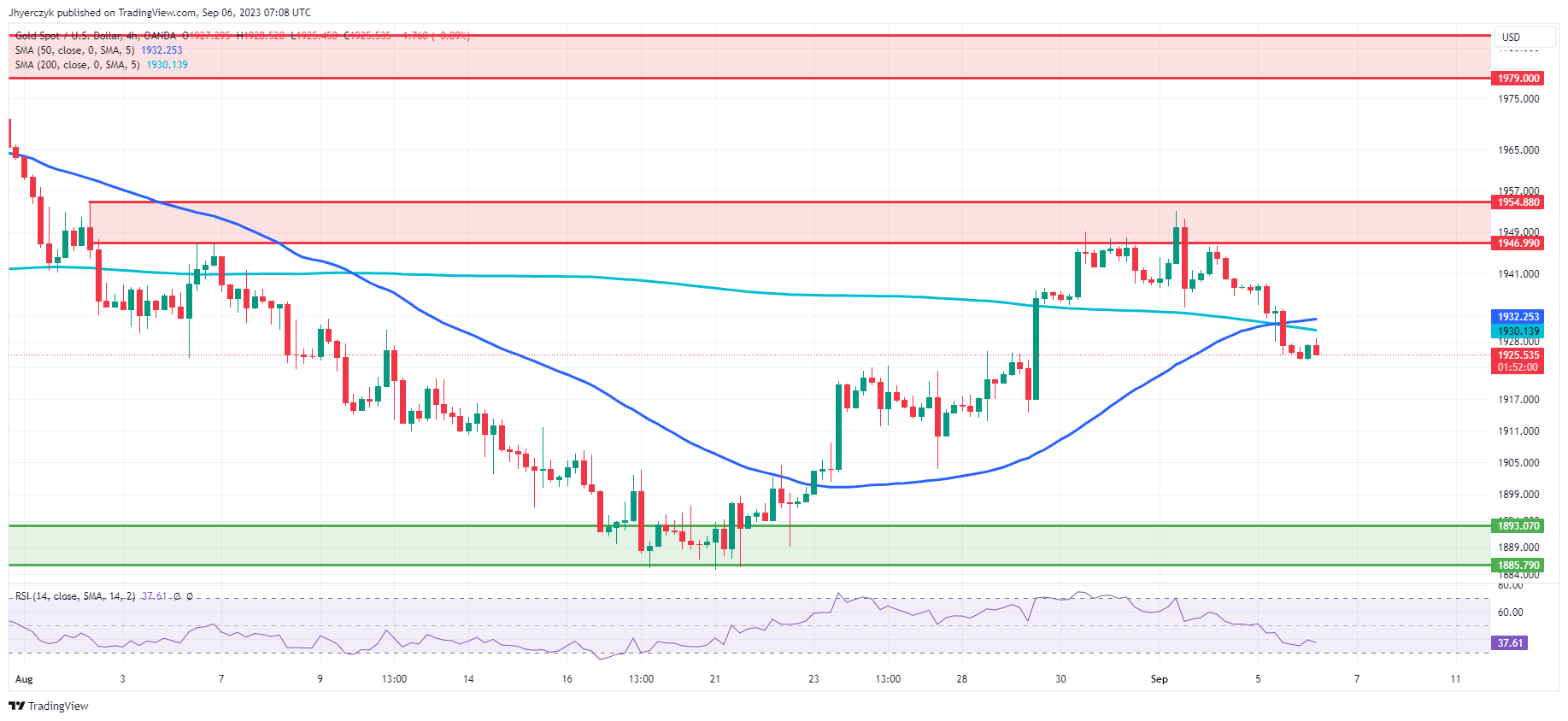
Gold’s current 4-hour price of 1925.51 sits below both the 200-4H moving average (1930.14) and the 50-4H moving average (1932.25), suggesting a bearish trend. The 14-4H RSI reading at 37.56 indicates weakening momentum but isn’t yet in the oversold territory.

Price-wise, Gold is hovering closer to the main support area (1893.07 to 1885.79) rather than the main resistance area (1946.99 to 1954.88). Given these indicators, current market sentiment for Gold on a 4-hour chart leans bearish.


