


LNG Is Doing the Lifting While Weather Is Still Sitting Out
November natural gas futures are higher Wednesday because LNG is taking supply out of the domestic market faster than the weather is taking demand away. Feedgas to U.S. LNG terminals jumped to nearly 20 Bcf per day Tuesday, the highest level in five and a half months. That is a real number. It is giving buyers a reason to take offers after the market held the $3.146 to $3.087 support zone earlier in the week.
The weather is not giving them much help. National demand stays light for the next few days and only improves to moderate over the weekend. That leaves the front month trading exports against comfortable storage, high production and another EIA report Thursday.
At 07:55 GMT, November natural gas futures are trading at $3.313, up $0.030 or 0.91%.

Exports Are Running This Trade
LNG flows hit 19.966 Bcf per day Tuesday, up 12.4% from the prior week. Lower-48 production was 109.5 Bcf per day, but nearly 20 Bcf of that is leaving the country. That is the strongest part of this trade. The export market is doing the work, not domestic consumption.
Domestic demand at 68.1 Bcf per day is not doing the bulls any favors and the generation number from Edison Electric is a footnote. LNG is the trade. If feedgas stays near 20 Bcf per day, buyers do not need the weather to show up.
Europe’s Storage Gap Keeps Cargoes Moving
European natural gas prices hit a three-and-three-quarter-year high Tuesday and the reason is simple. Storage was 74% full as of October 11. The five-year seasonal average is 89%. That is a real gap heading into winter and European buyers know it.
U.S. cargoes are not going to sit on the dock with that kind of spread open. Nobody is buying November futures because the U.S. weather forecast looks cold. They are buying because Europe needs the gas and the U.S. has it. That does not guarantee a straight-line rally. It does put a floor under this trade that weather alone would never give you.
Natural Gas Price Forecast
Every new Natural Gas analysis as it publishes, today's technical signal and key levels, live price — on one page.
See all Natural Gas forecastsWarm Pattern Caps the Upside
The weather is not helping this trade and the forecast says that is not changing. Demand stays light through midweek. There is no sustained cold anywhere in the models.
That leaves buyers leaning entirely on LNG. Additional heating-degree days in the northern U.S. would give them a second reason to hold. The models are not showing it yet.
Sellers Still Have Storage on Their Side
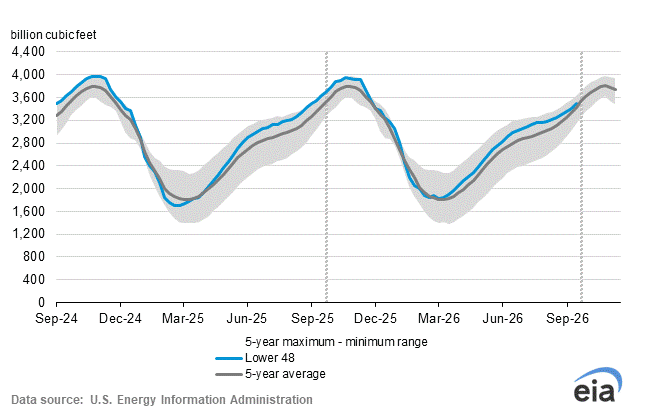
Last week’s 85 Bcf injection topped the 82 Bcf estimate. That looks bullish until you see the five-year average build at 96 Bcf. Inventories were 3.9% below last year and still 2.0% above the five-year seasonal average. The market has enough gas and every rally still has to earn it.
EIA projects end-of-October storage at 3,985 Bcf, the highest in a decade. The 2027 production forecast went up too, 116.0 Bcf per day from 115.3 Bcf. Baker Hughes had the rig count down one at 132. Three data points, same story. There is no supply squeeze coming.
Thursday’s report is the next test for both sides. LNG is tightening the front of the curve. Storage is still telling sellers they have time.
Daily November Natural Gas Futures Technical Analysis
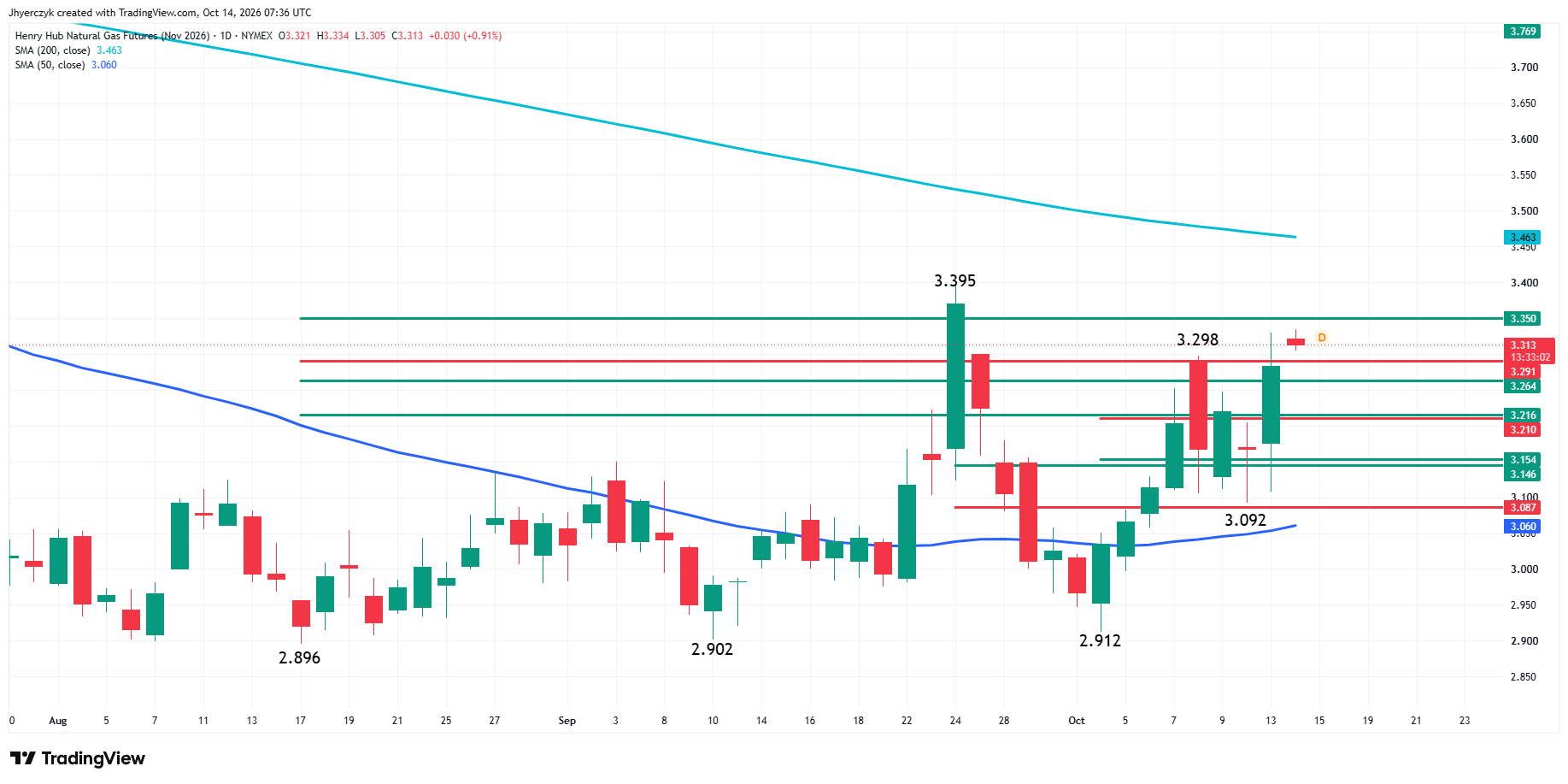
November natural gas futures are higher early Wednesday.
The main trend is up according to the daily swing chart. It turned up on Tuesday when buyers took out the previous swing top at $3.298. The new main bottom is $3.092. A trade through this level will change the main trend to down.
Several retracement zones have played a role in developing the current up move. The first key area at $3.146 to $3.087 provided the main support earlier in the week when buyers helped put in the main bottom at $3.092 on October 12.
After grinding through potential resistance levels from $3.154 to $3.264, November natural gas is now positioned to challenge the key retracement zone resistance at $3.291 to $3.350.
The market still has to overcome a key 50% level at $3.350 and the main top at $3.395 to continue the rally.
The current setup is also supported by the 50-day moving average at $3.061. Taking out $3.395 will put the 200-day moving average at $3.463 on the radar.
What to Watch
LNG is the only reason buyers are taking offers. Sustained feedgas near 20 Bcf per day keeps the bid intact. Additional heating-degree days in the northern forecast and a light storage build on Thursday would give buyers enough to push into $3.350. Europe’s winter storage gap is doing the rest from the other side of the Atlantic.
The trend turned up Tuesday and the bias is bullish above the support zone at $3.146 to $3.087. The September 24 main top at $3.395 is the trigger for the next leg. That level opens a run at the 200-day moving average at $3.463. A comfortable number on Thursday’s report and more warmth in the extended forecast would hand sellers the room to test support again.
LNG has changed the tone. It has not erased the supply problem.
More Information in our Economic Calendar.


