



Key Points
- Strong U.S. Dollar, Fed’s stance affect oil futures.
- China’s economic slowdown pressures global oil demand.
- Middle East conflicts disrupt oil supply and shipping.
- OPEC’s January production drops significantly.
The Fed and the Dollar Impact
Crude oil futures are exhibiting a mixed performance early Thursday, influenced by a strong U.S. Dollar and Federal Reserve’s recent hawkish stance. The dollar’s strength, particularly against the euro, was bolstered by Fed Chair Jerome Powell’s remarks, which downplayed the likelihood of an interest rate cut in March. This development has significant implications for dollar-denominated assets like crude oil.
At 08:16 GMT, Light Crude Oil Futures are trading $75.77, down $0.08 or -0.11%.

China’s Economic Slowdown
China, a major crude importer, is showing signs of economic strain, with manufacturing activity contracting for the fourth consecutive month in January. The troubles in China’s real estate sector, highlighted by the liquidation of China Evergrande, further exacerbate concerns. These factors are crucial as China’s consumption is a key driver of global oil demand, with organizations like OPEC forecasting demand growth primarily fueled by the Chinese market.
U.S. Inventory and Production Shifts
The U.S. Energy Information Administration reported an unexpected rise in crude inventories, with a 1.2 million barrel increase against the anticipated 217,000 barrel draw. This inventory build, coupled with a rebound in U.S. oil production to 13 million barrels per day (bpd) following weather-related disruptions, adds pressure to oil prices. Additionally, refinery utilization rates have dipped, indicating a slower pace in refining activities.
OPEC’s Production Trends
OPEC’s output in January saw a significant drop, the largest since July, due to voluntary production cuts and disruptions in Libyan output. This decrease in production, totaling 410,000 bpd from December, could influence global supply balances.
Geopolitical Tensions in the Middle East
The ongoing conflict in the Middle East, particularly the Israel-Hamas war and tensions in the Red Sea involving the U.S. and Iran-aligned Houthi militants, is causing disruptions in oil and natural gas tanker shipping. These geopolitical tensions are raising delivery costs and could potentially impact oil supplies, although the technical outlook for crude oil remains bearish.
Short-Term Market Forecast
Considering these factors, the short-term outlook for crude oil markets appears bearish. The combination of a strong U.S. dollar, China’s economic slowdown, increased U.S. crude inventories, and ongoing geopolitical tensions in the Middle East are likely to weigh on oil prices. However, OPEC’s production cuts could provide some support to the market. Investors should closely monitor these developments for potential shifts in the market trend.
Technical Analysis
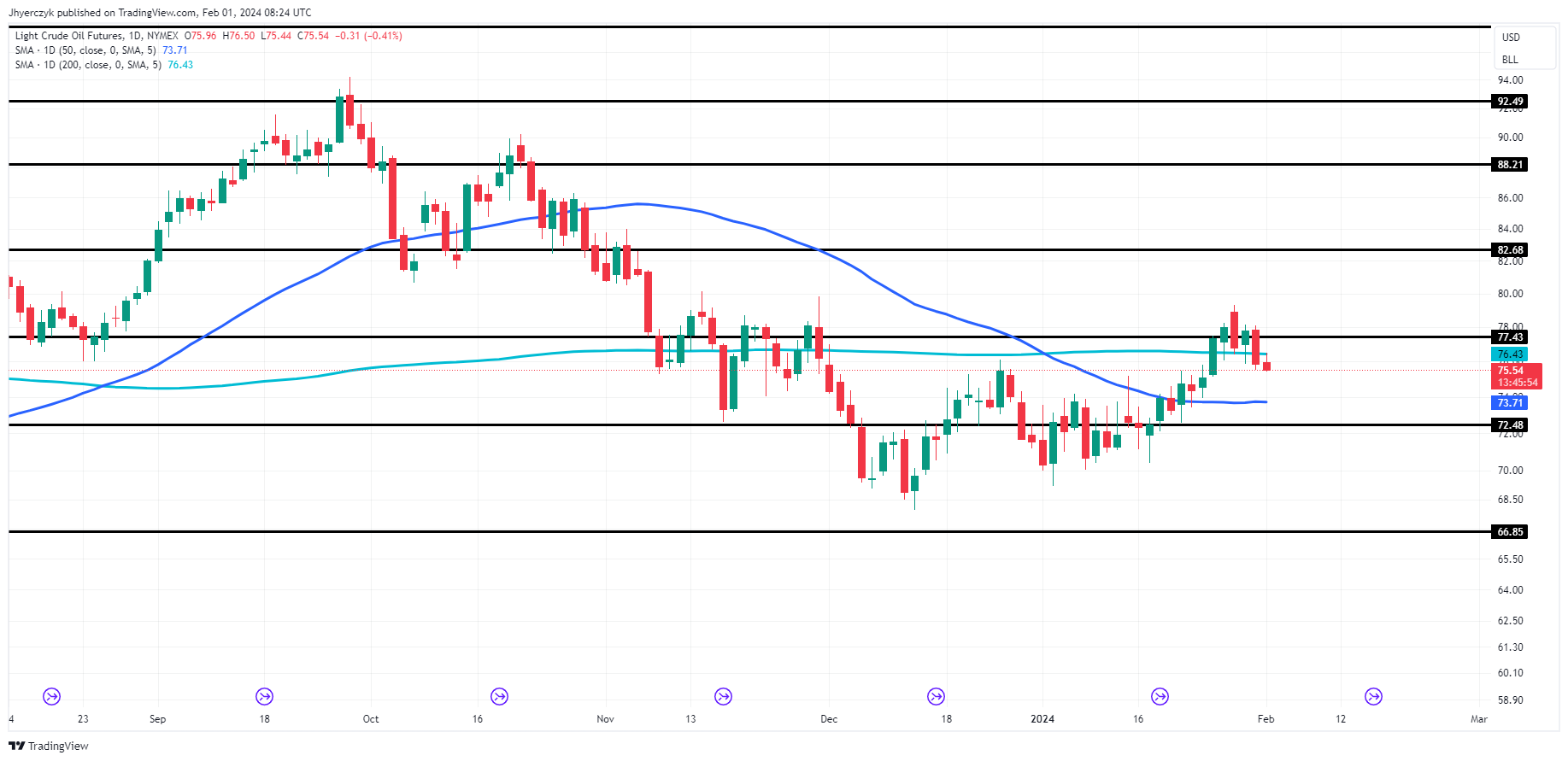
Light crude oil futures are edging lower. After posting a mixed performance earlier in the session, sellers started to gain control when the market crossed to the bearish side of the 200-day moving average at $76.43. This indicator is now new resistance.
If the downside momentum continues to build then prices could easily slide into the 50-day moving average at $73.71. Conversely, recovering the 200-day MA could bring some life back into the market, but buyers would still have to overcome the pivot at $77.43 in order to build on the move.


