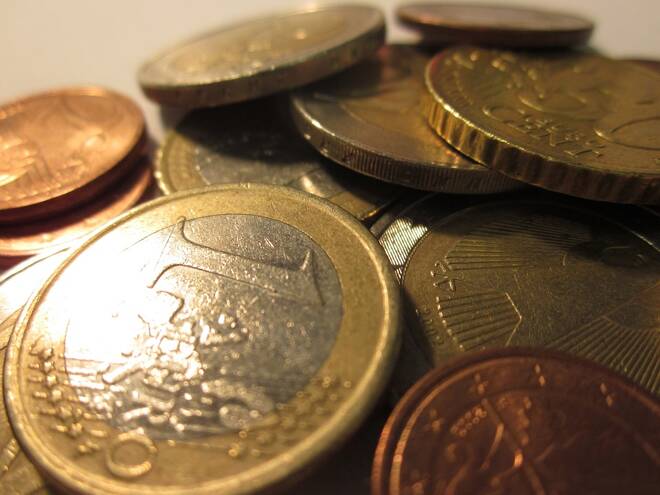
The euro has risen to buying $1.11 this morning GMT, the highest its has been against the US dollar since October last year.
Since yesterday afternoon GMT, the euro has steadily climbed against the greenback from buying just over £1.09.
The euro’s appreciation over the dollar stems from several macro economic factors, including the calming of speculation over a Federal Reserve rate rise.
Recently the United States has received some weak economic data, including consumer prices slipping by 0.1% in December.
And the latest Purchasing Manager’s Index released by global financial research company Markit, revealed that the manufacturing sector in the United States rose only slightly in January to 51.4 from 51.2 in December.
This was the survey’s second lowest reading since October 2013.
Falling oil prices have also weighed down United States economy, even though the price of a barrel of crude oil has slightly increased in the past 48 hours, to $35.17 per barrel.
The recent positive unemployment data in the euro area, which fell by 0.1% in December last year compared to November, has also fortified the euro in the eyes of traders.
UK Pound weakens to the Euro Surge
The euro also strengthened against the UK pound in the past 24 hours, and is currently buying £0.76, an increase from £0.753 yesterday afternoon GMT.
The euro’s rise has coincided with the release of the draft EU reform deal, which has failed to persuade many euro sceptics in the UK, that the outcome of the negotiations was strong enough for Britain’s fortunes.
Since the beginning in December, the pound has been emasculated by the rising euro, then the euro was buying £0.72.
Later today, the Banks of England will reveal the latest interest rate and inflation figures, as part of the ‘super Thursday’ release of economic data.
Interest rates are almost certain to remain unchanged, as the bank’s governor Mark Carney has strongly hinted that he will not hike interest rates, due to deflationary pressures, and the expected slowdown in global growth.
Retail Trade Volume Increases by 0.3% in Euro Area
Eurostat data has unveiled encouraging news for the retail trade sector, as it increased by 0.3% in December last year, compared to November.
This was an improvement in contrast for the results for November, which were only stable from the previous month.
In the European Union, retail trade also grew month on month, but at a relatively slower pace of 0.1%.
The main influences for the rise in the euro area is due to the rise in food, drinks and tobacco by 0.6%, and a further 0.2% for non food products.
In the European Union, the 0.1% rise mainly arrived from the 0.8% rise in food, drinks and tobacco, while non-food products and automotive fuel both fell by 0.4%.
US Dollar Index Price Forecast
Every new US Dollar Index analysis as it publishes, today's technical signal and key levels, live price — on one page.
See all US Dollar Index forecastsThe year on year comparison for December showed that the retail trade sector had accelerated by 1.4% in the euro area, and by 2% across the European Union.
On average, the total retail trade for last year rose by 2.4% compared to 2014, and in the European Union it rose to 3%.