



Key Points
- U.S. labor strength impacts gold prices negatively
- Dollar and Treasury yields influence gold’s retreat
- CPI, PPI reports crucial for next week’s gold forecast
Gold’s Weekly Wind: A Tale of Economic Shifts and Fed Expectations
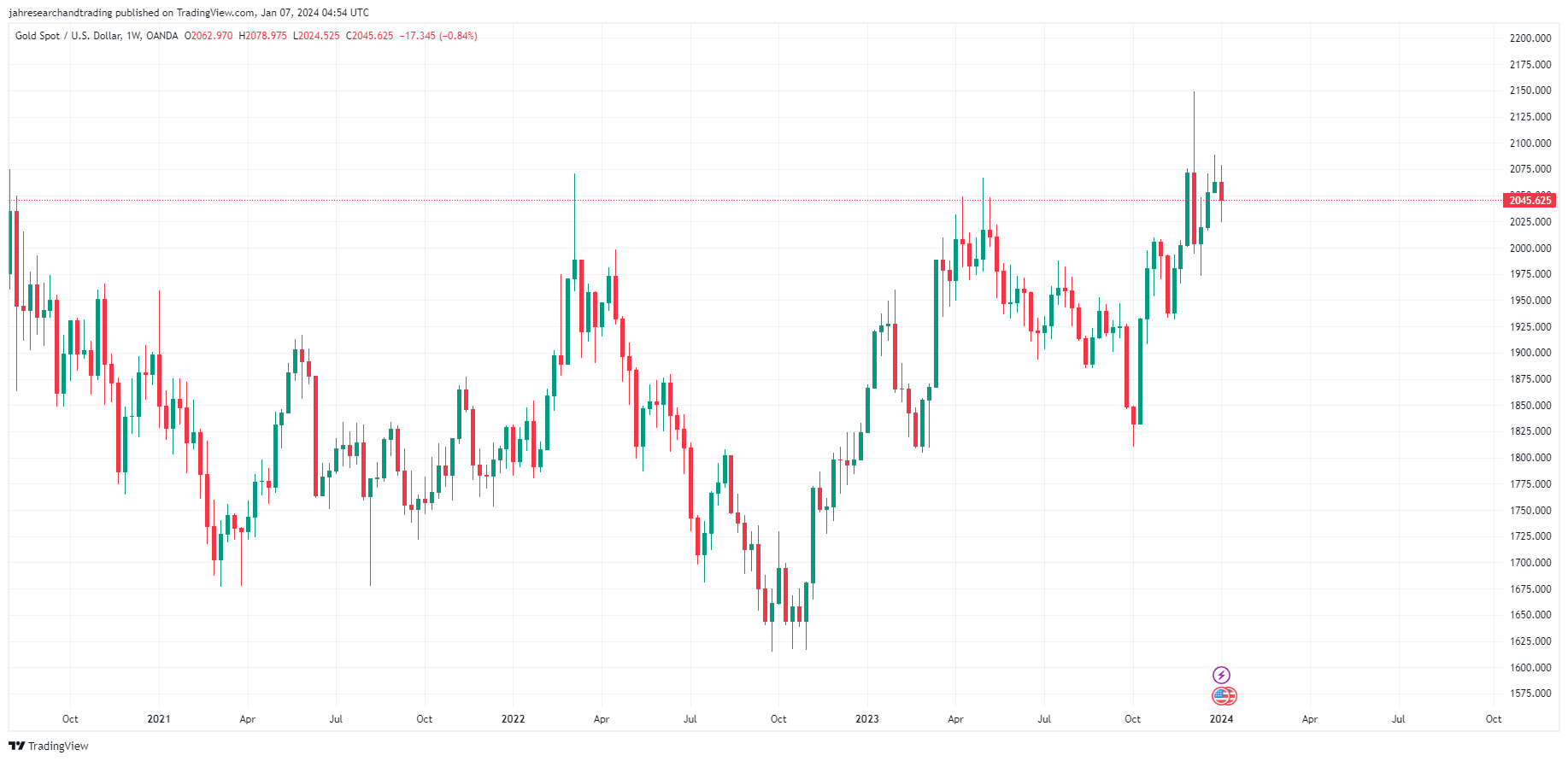
This week’s gold market experienced its first decline in four weeks, shaped by a mix of U.S. economic reports, Federal Reserve policy prospects, and currency trends. Gold (XAU/USD) ended at $2045.625, marking a drop of 0.84%, while February Comex gold futures closed lower by 1.06% at $2049.80.

Labor Data and Gold’s Response
A significant factor this week was the U.S. labor market’s unexpected strength. The Non-Farm Payrolls report showed an addition of jobs well above market estimates, casting doubts on an early Federal Reserve rate cut in March. This robust job growth exerted a downward pull on gold prices, though this was partly balanced by weaker ISM service sector data, signaling a potential economic slowdown.
Dollar Strength and Yield Impact
The ascension of the U.S. Dollar and 10-year Treasury yields to their three-week peaks played a crucial role in the retreat of gold prices. The strengthened dollar reduces gold’s attractiveness to holders of other currencies, contributing to its price fall.
Fed Rate Cut Speculations
The speculation around the Federal Reserve’s rate decisions has been a driving force in recent market movements. Although more aggressive rate cuts were expected earlier, the recent labor market data has led to more cautious expectations. The ambiguity in the Fed’s policy meeting minutes has spurred diverse market predictions.
Forecasting Gold’s Path in the Coming Week
The upcoming week will be pivotal for gold traders, as focus turns to key economic reports and their potential influence on the Fed’s policy. The market is currently leaning towards a 67% probability of a Federal Reserve rate cut by March. However, the strong inflation market figures might modify these odds.
The upcoming CPI and PPI reports are critical. Forecasts suggest a potential rise in the headline CPI by 0.3% month-on-month, with core CPI (excluding food and energy prices) also expected to increase by a similar margin. These figures, if realized, would indicate a cooling inflation trend but still above the Fed’s 2% annual target. Such outcomes could impact the timing and scale of anticipated interest rate cuts.
In conclusion, gold traders should brace for a week where economic reports, especially the CPI and PPI, could significantly sway market sentiments. These reports will not only influence the Federal Reserve’s rate decision but also shape the U.S. Dollar’s strength and Treasury yields, directly affecting gold prices. Closely monitoring these developments will be essential for understanding gold’s short-term movements.


