
To make it happen, sensors, a “brain,” and physical output must work in unison. And there are two companies playing key roles in the chain.

Two Key Robotics Stocks
Physical’s AI layers involve compute power for the “brain,” sensors for power and motion, as well as testing to validate results and avoid errors. All this matters in automation, which is still early in terms of scaled output.
Let’s discuss two companies involved in the physical AI layers. The first is Nvidia (NVDA), the leading designer of key AI chips with a $5.7 trillion market capitalization. It is physical AI’s “brain.”
CEO Jensen Huang said physical AI revenue could hit up to $100 billion within a decade. That would add to an already booming business.
Sales are estimated to reach nearly $692 billion in 2028 and $924 billion in 2029. Net income projections are for $379 billion in 2028 and $505 billion in 2029. Even better, it has a forward price-earnings ratio of just over 17x, which is a cheap valuation for NVDA.
No wonder it’s landed on our Outlier 20 report repeatedly for years. Few companies have the fundamental and technical scores for such an elite level:
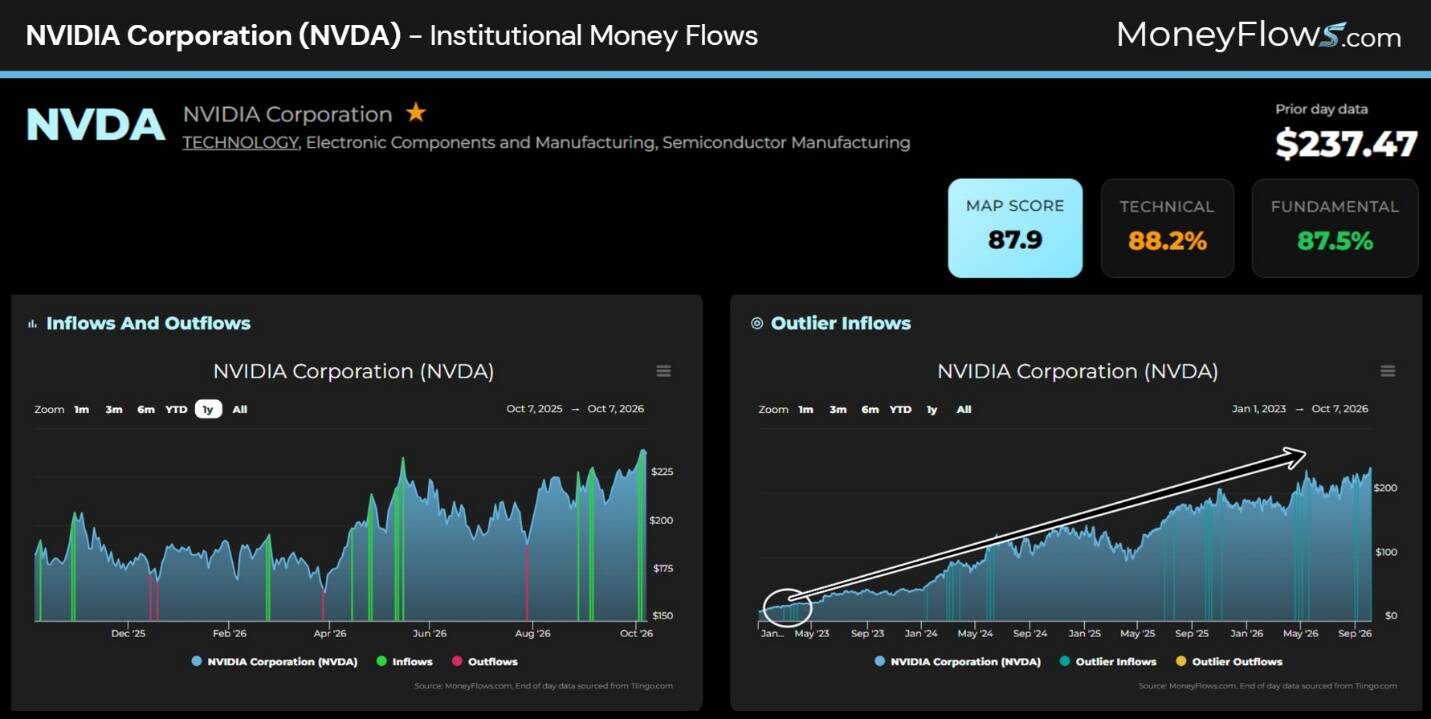
When stocks receive such strong institutional support, their growth is almost limitless.
The next key AI robotics stock to own is Analog Devices (ADI), a company that produces many products, including power management solutions and sensors for AI. ADI’s sensors help machines make sense of the world.
It’s a $200 billion market cap company with shares that have gained 57% so far in 2026. It’s not a surprise when viewing the fundamentals – industrial sales were nearly $3 billion last quarter and per-share earnings are projected to be $12.87 for the year.
The earnings picture grows substantially in the future, with analysts predicting EPS of $16.66 and $19.66 in 2027 and 2028, respectively. That’s definitely brought Big Money to the table:
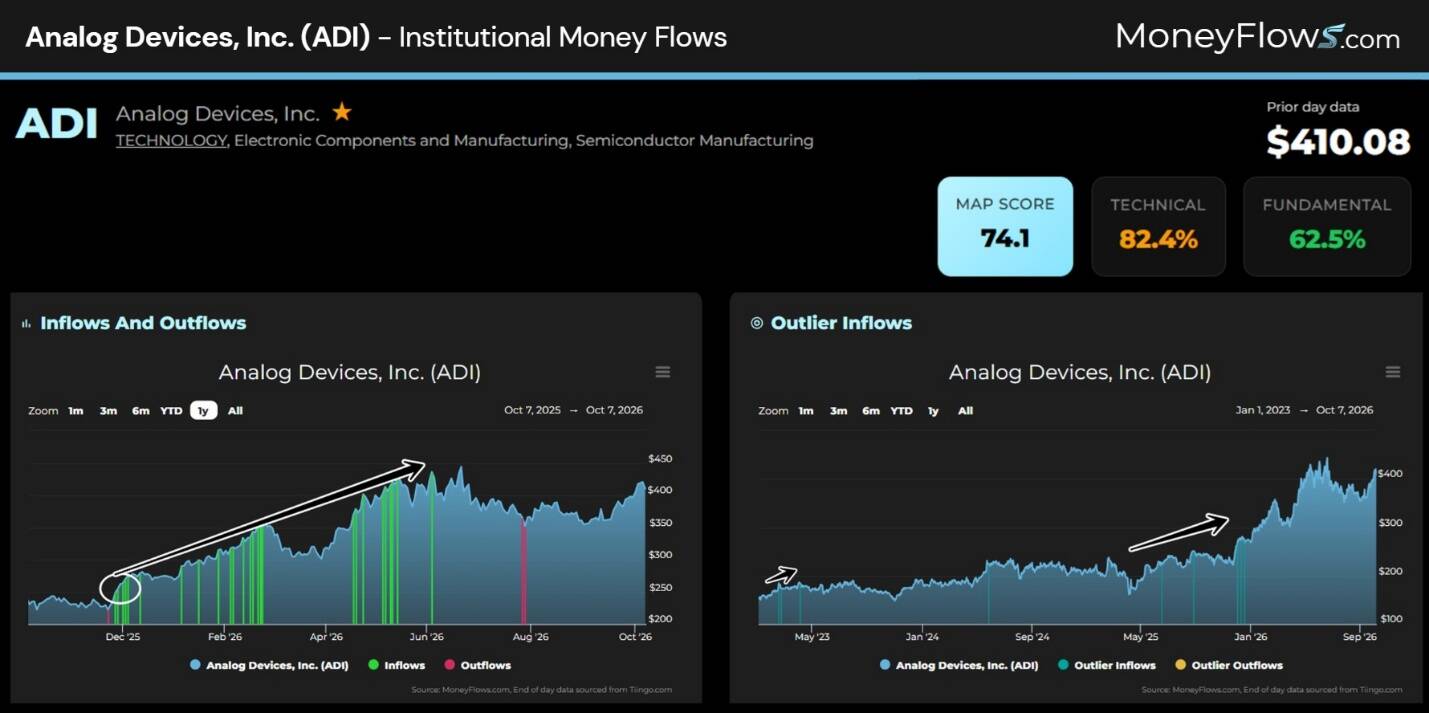
ADI has been a top name for institutional inflows. Big Money has been aggressive this year, boosting share prices along the way.
The Next Frontiers
NVDA and ADI are institutional favorites and part of our new MoneyFlows Frontiers. Both are in the AI Frontier and NVDA is in Robotics too.
These companies are increasingly becoming part of the physical AI wave unfolding globally. Institutional investors recognize this opportunity have been pouncing – it’s in the data. You could too.
If you are a Registered Investment Advisor (RIA) or a serious investor, take your investing to the next level. MoneyFlows created 11 Frontiers indexes to help serious investors capture AI-driven themes and learn the leading stocks in each Frontier. Get started here.
Disclosure: at the time of publication, the author holds long positions in ADI in managed accounts and no position in NVDA.