Henry Hub natural gas’ near-term fundamental question revolves around whether late-October weather will leave enough heating demand to tighten an otherwise adequate national storage position.
NOAA’s Climate Prediction Center issued a new outlook on October 19 favoring above-normal temperatures across much of the U.S. for October 25–29. Warm-category probabilities exceeded 50% in parts of the Central Plains, Middle Mississippi Valley, and Great Lakes.

Warmer Weather to kick off November
For the following October 27–November 2 period, NOAA again favors warmth east of the Rockies, while noting that the area of higher probabilities has contracted as uncertainty increases. The Eastern Seaboard is closer to normal in the earlier period, and parts of the Northwest and Northern High Plains do drift a little cooler.
The geographic detail matters. A broad warm headline can conceal certain regions having higher heating requirements. I interpret this as the forecast, weather-wise, still leaning against immediate widespread heating-driven tightening of supply. This, of course, will remain conditional based on temperatures actually developing as meteorologists predict, but at this stage of the season, a change in the placement or persistence of colder air could alter expected withdrawals pretty quickly before consumption is measured.
Latest EIA Report
The latest EIA storage report was released October 15 and covers the week ending October 9. Estimated Lower 48 working gas was 3,567 billion cubic feet after a 67 billion cubic feet injection. Inventories were 45 billion cubic feet above the corresponding five-year average but 143 billion cubic feet below last year.
Distribution of Supply
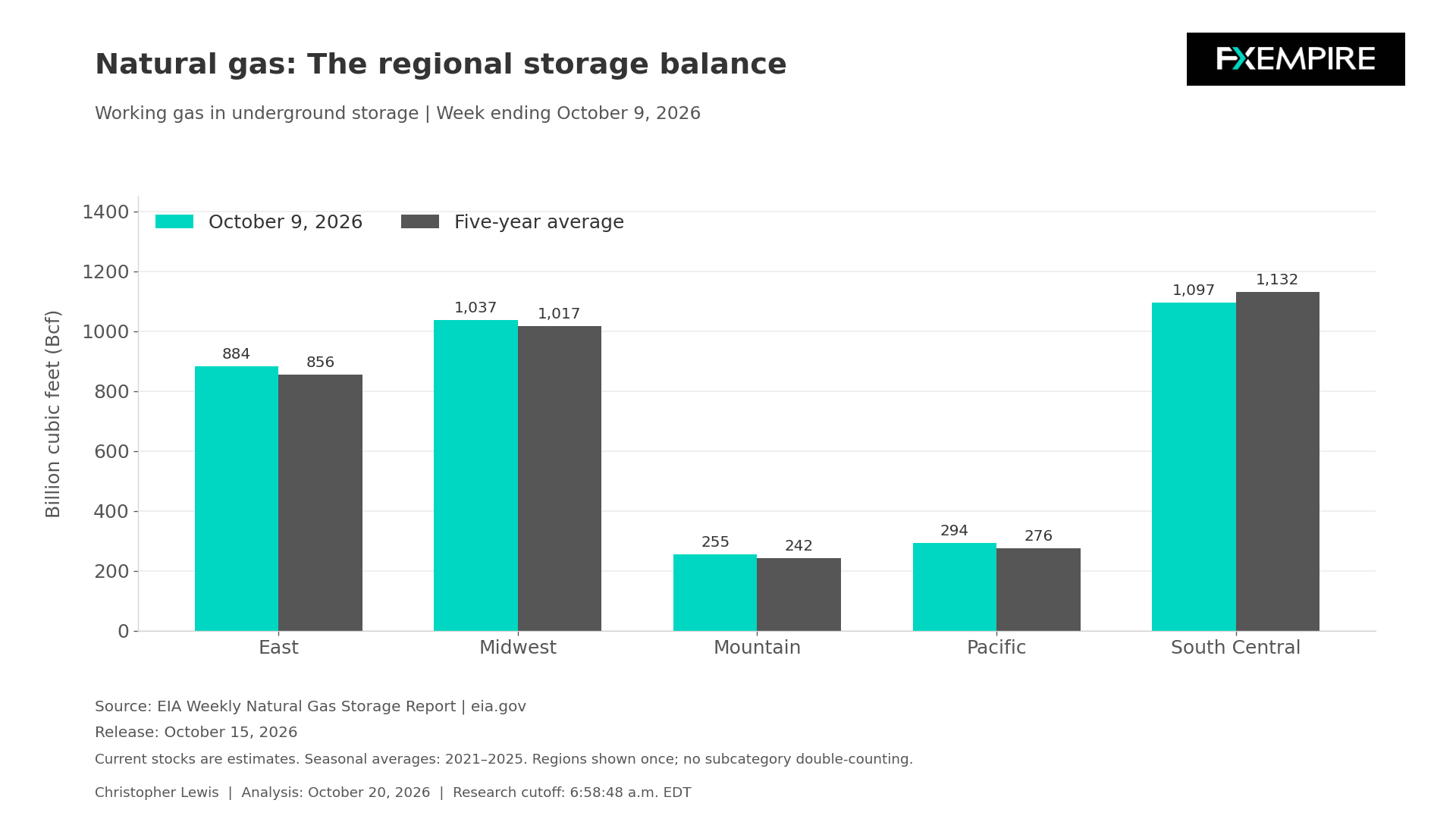
These comparisons point in different directions. The U.S. has a modest cushion against its seasonal norm while holding less gas than it did last year. Distribution by region makes the number less reassuring for every part of the system. South Central inventories were at 1,097 billion cubic feet, below their 1,132 billion cubic feet five-year average. By contrast, the East held 884 billion cubic feet against an average of 856 billion cubic feet, and the Midwest held 1,037 billion cubic feet against 1,017 billion cubic feet.
Natural Gas Price Forecast
Every new Natural Gas analysis as it publishes, today's technical signal and key levels, live price — on one page.
See all Natural Gas forecastsMountain and Pacific stocks were also above their respective averages, but regional totals can sometimes skew the number by offsetting each other in a way that a single national comparison does not reveal. This is relevant to the Henry Hub assessment because the location and accessibility of the stored supply affect how readily it can meet competing requirements. A national surplus cannot establish that every region of the United States has a delivery mechanism that meets demand easily. Equally, a regional deficit alone does not provide a national shortage or specific pipeline bottleneck story.
EIA Short-term
EIA’s October Short-Term Energy Outlook provides a separate planning baseline. Published October 6 with forecasts completed October 1, it projects end-October inventories of 3,850 billion cubic feet, approximately 2% above the five-year average. This is a forecast, not an observation already achieved, so it should be taken into account that it is predictive, not responsive. It also predates the October 19 NOAA outlook.
Power-sector consumption may complicate the weather relationship. Warmer conditions may reduce heating requirements while supporting cooling load in some areas, especially the Deep South. LNG exports and production can also change the amount available for storage. However, the official daily feed gas, terminal operation, or production flow series do not suggest this is going on quite yet.
Storage Report
The next EIA storage release is scheduled for Thursday and is still pending. A smaller injection, or perhaps an unexpected withdrawal, especially alongside a colder forecast revision, could strengthen the tighter-balance interpretation. But as things stand right now, continued builds and persistent warmth are weakening it.
The present evidence supports a cautious reading: a modest national buffer, an uneven regional cushion, and forecasts that restrain the case for immediate heating pressure.
Technical Analysis
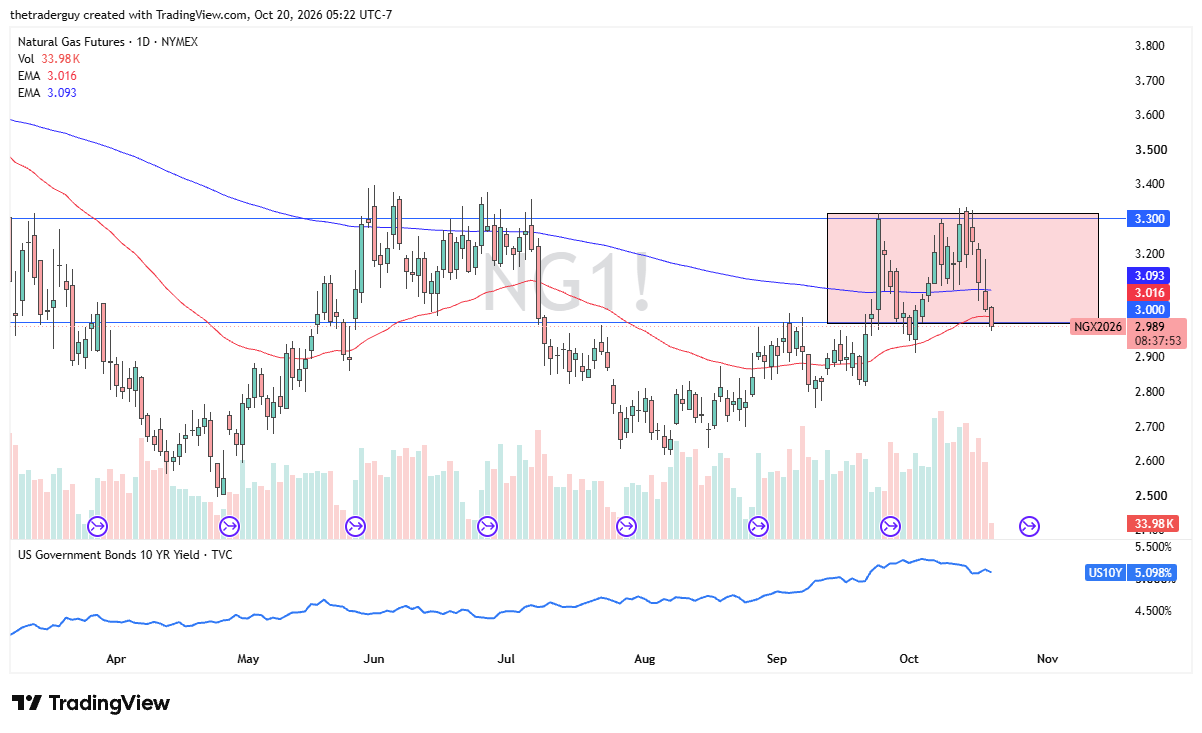
Natural gas finds itself trying to break through the $3 level, and the daily close today should be important. Something below $3 would be rather bearish, although one would assume there is plenty of support underneath. If the market can recapture $3 and perhaps even break above the 50-day EMA, it may lead to more consolidation between the crucial $3 level on the bottom and $3.30 level on the top.