
USD/JPY extended its losing streak in a choppy week, with the BoJ, intervention, warnings, and Trump’s Fed Chair nomination fueling market volatility.
The Bank of Japan’s upward revisions to GDP and inflation projections, a hawkish BoJ Governor Kazuo Ueda, and yen intervention threats sent USD/JPY to a weekly low of 152.092 in the week ending January 30.
However, softer Japanese economic data, sticky US producer prices, and President Trump’s nomination for Fed Chair led to a partial recovery. USD/JPY ended the week down 0.64% at 154.750, below the crucial 155 level.
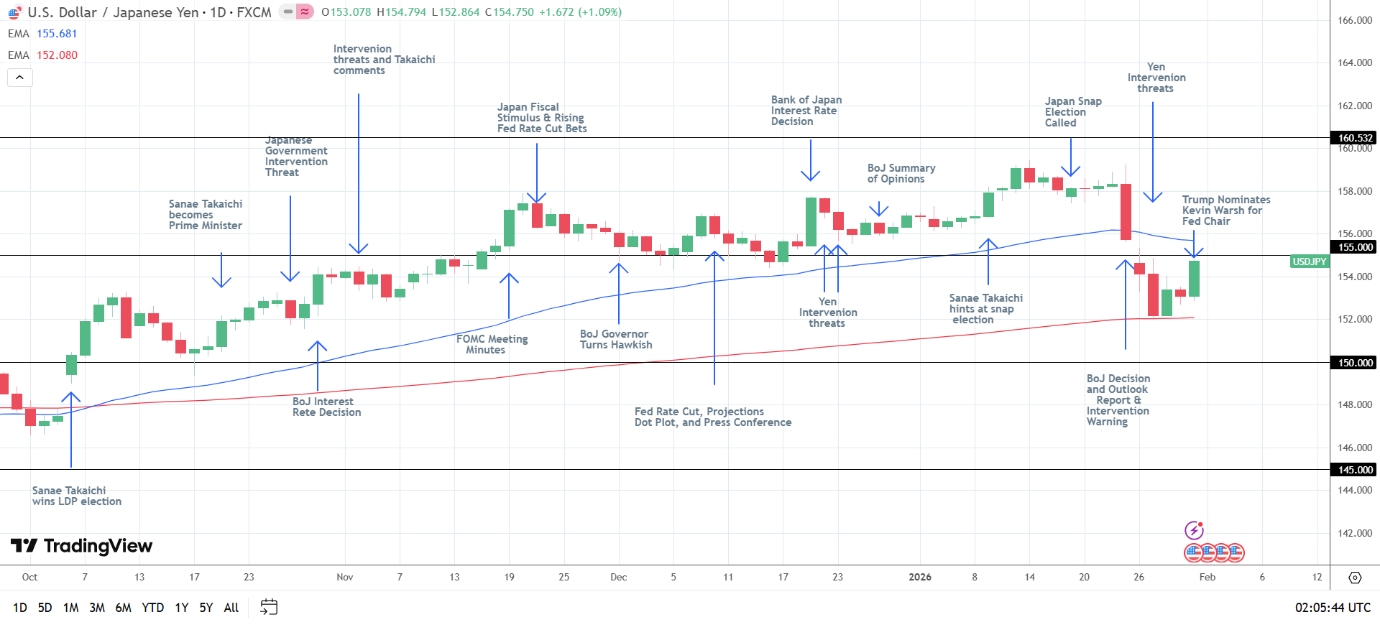
Last week’s drop below 155, expectations of multiple Fed rate cuts, and a hawkish BoJ rate path support a bearish short- to medium-term price outlook for USD/JPY.
Below, I examine the upcoming economic calendar, the medium-term catalysts (4-8 weeks), and the technical levels traders should watch.

Key Japanese Economic Indicators to Look Out For
In the week ahead, the Bank of Japan, Japanese economic data, and political headlines will influence buying interest in the yen. Key economic indicators include finalized PMI numbers and household spending figures.
Preliminary manufacturing and service sector PMIs signaled a sharp pickup in economic momentum, supporting a hawkish BoJ policy stance. Upward revisions to the preliminary PMIs would reinforce the BoJ’s positive economic outlook. These factors raised expectations of an H1 2026 rate hike. A more hawkish BoJ rate path would boost yen demand, sending USD/JPY lower.
Meanwhile, December’s household spending figures will face scrutiny after retail sales unexpectedly fell at the end of 2025. Economists expect household spending to fall 1.3% month-on-month after surging 6.2% in November.
A larger-than-expected fall in household spending would offset the pickup in service sector consumption, cooling bets on an April BoJ rate hike. For context, private consumption contributes around 55% to Japan’s GDP, while the services sector accounts for roughly 70% of GDP.
However, the BoJ’s concerns over yen weakness driving import prices higher may lead to hawkish rhetoric. Typically, rising import prices fuel inflationary pressures, eroding households’ spending power. Policymakers want to avoid the combination of rising inflation and weakening domestic demand, which would adversely impact the economy and trigger price instability.
USD/JPY Price Forecast
Every new USD/JPY analysis as it publishes, today's technical signal and key levels, live price — on one page.
See all USD/JPY forecastsBank of Japan Summary of Opinions in Focus
While the economic data will be key, the BoJ’s Summary of Opinions will give insights into the requirements for a rate hike. The BoJ will release its Summary of Opinions on Monday, February 2.
Increased optimism that tariff risks have abated, wage growth will continue to accelerate, and the economy and prices will move in line with projections would support a hawkish policy stance.
Traders should also consider any references to the Bank of Japan’s neutral rate, neither accommodative nor restrictive. A higher neutral rate (potentially 1.5% – 2%) would indicate multiple BoJ rate hikes and a sharply narrower US-Japan rate differential.
Narrowing rate differentials would push USD/JPY lower. Importantly, these scenarios could trigger a yen carry trade unwind as seen in mid-2024, exposing USD/JPY to sub-140.
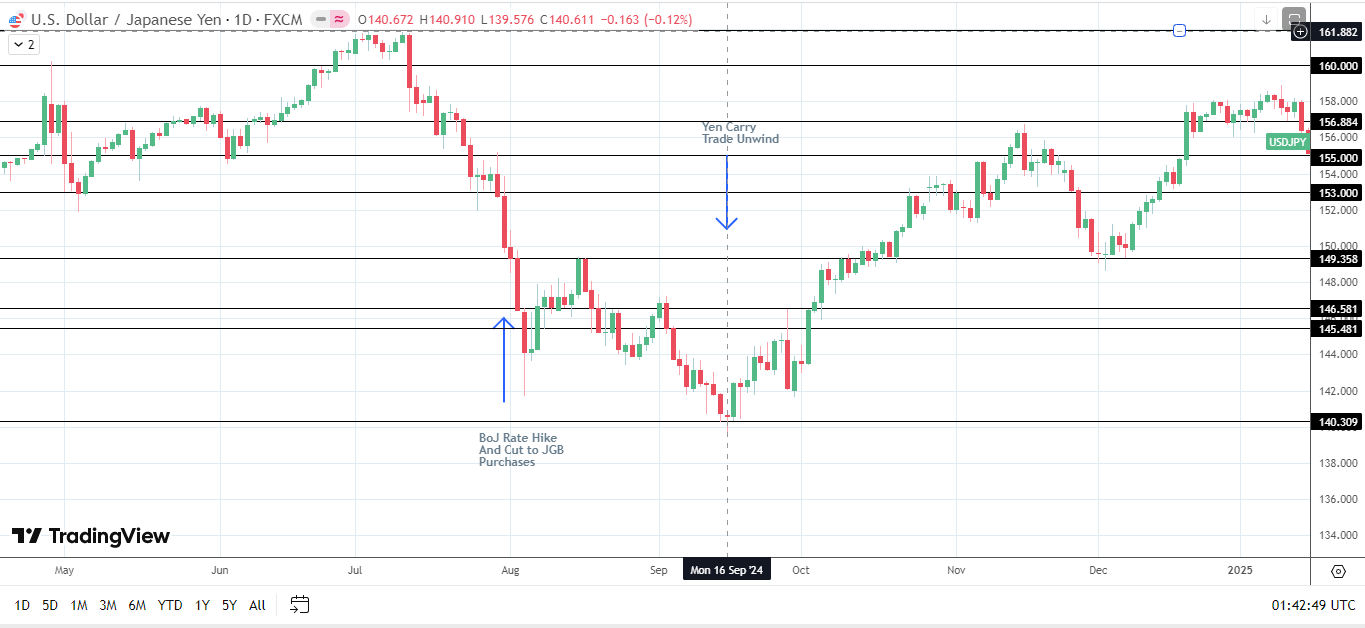
Meanwhile, traders also need to consider the broader economic picture, not just an isolated drop in consumer spending and January’s softer inflation numbers.
Steady labor market conditions, improved external demand for Japanese goods, and higher wages would lift consumer sentiment. Rising sentiment would drive spending, bolstering the economy, while fueling demand-driven inflation. These dynamics support a more hawkish BoJ rate path, weighing on USD/JPY.
Follow real-time updates to stay ahead of USD/JPY market developments.
Japan’s Snap Election Looms
Japan’s national election will be another market focal point, as voters go to the polls on February 8. Prime Minister Sanae Takaichi called a snap election in January, looking to leverage her strong personal approval ratings to gain a firmer footing in the lower house.
A strong election win would give the Japanese Prime Minister greater freedom to pursue her fiscal spending plans. USD/JPY surged from an October 3 low of 147.056 to a January high of 159.454 amid concerns over Prime Minister Takaichi’s fiscal policies and Japan’s 240% debt-to-GDP ratio. Prime Minister Takaichi’s spending and debt-to-GDP balancing act will be key for USD/JPY trends.
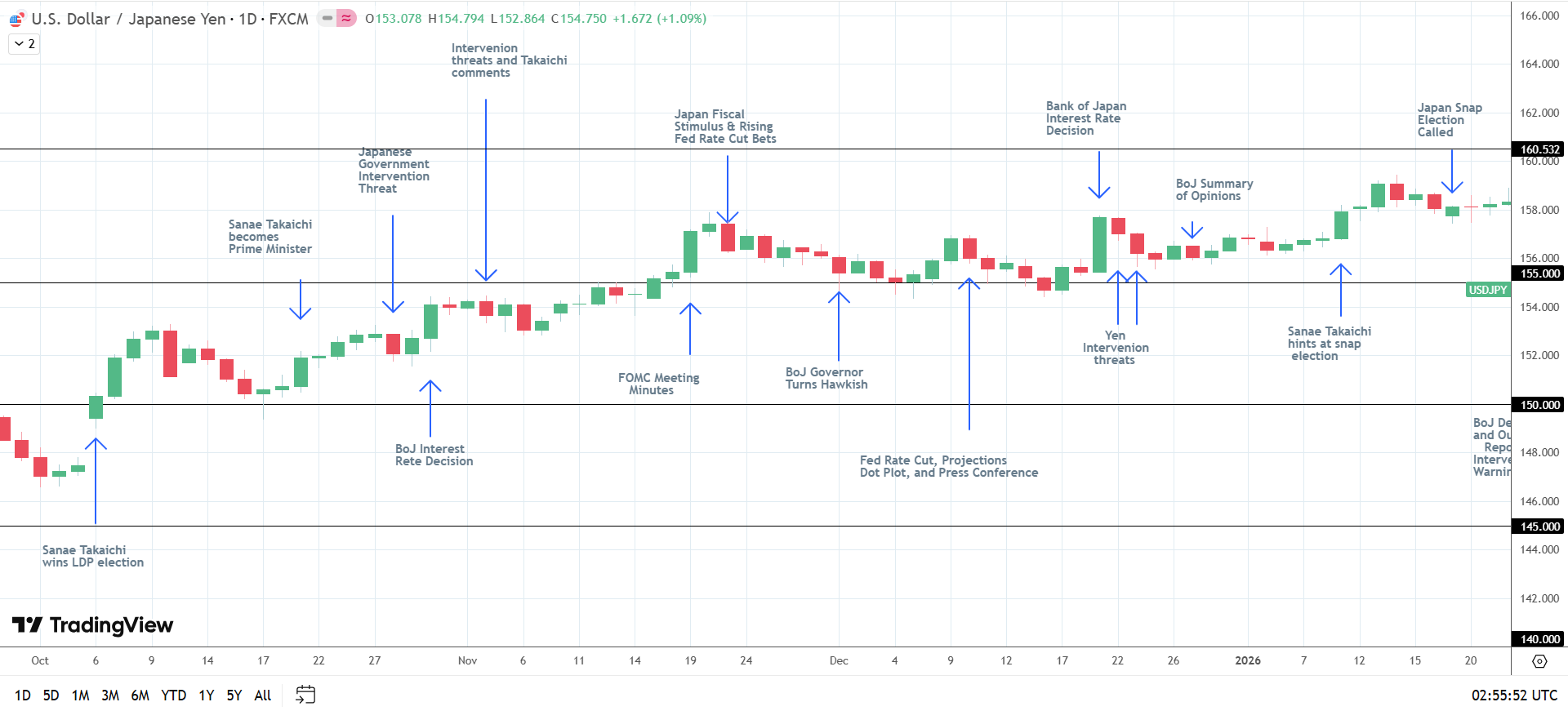
Meanwhile, China may also reconsider its stance on Japan if Takaichi impresses in the polls and rebuilds diplomatic relations, a positive for the yen.
US Economic Calendar: Services PMI, Labor Market Data, and the Fed to Spotlight the Greenback
While Japanese economic data, the BoJ’s policy stance, and the election influence the yen, US economic data and Fed chatter will dictate US dollar trends.
The US ISM Services PMI on February 4 and the jobs report on February 6 will influence the Fed rate path and US dollar demand.
Economists expect the ISM Services PMI to fall from 54.4 in December to 53.8 in January. A lower PMI reading would signal a loss of economic momentum, given that services account for around 80% of US GDP.
Traders should also consider the labor market and prices sub-components, given the Fed’s dual mandate. Weaker labor market conditions and softer prices would likely raise bets on an H1 2026 Fed rate cut. A more dovish Fed rate path would weigh on the US dollar, sending USD/JPY lower.
Economists forecast a steady unemployment rate (4.4%) in January. Meanwhile, economists expect wage growth to slow from 3.8% YoY in December to 3.6% YoY in January. Weaker wage growth would signal a pullback in consumer spending, cooling demand-driven inflation. A softer inflation outlook would support a more dovish Fed rate path, affirming the bearish short- to medium-term price outlook for USD/JPY.
Beyond the data, traders should closely monitor FOMC members’ speeches for insights into the timing of a rate cut.
According to the CME FedWatch Tool, the probability of a March 2026 Fed rate cut stood at 13.4% as of January 30, down from 50.9% as of December 30. Additionally, the chances of a June cut stood at 61.8%, down from 84.5% as of December 30. Shifts in the chances of March and June cuts will be key for US dollar trends.
Market View: Medium-Term Yen Strength
In my opinion, USD/JPY would likely drop toward 150 on expectations of multiple Fed rate cuts and a hawkish BoJ rate path. These scenarios would affirm the bearish medium-term outlook. A break below 150 would reinforce the medium-term (4-8 weeks) to longer-term (8-16 weeks) 145-140 range.
Counter-Trend Risks: What Could Drive USD/JPY Toward 160?
Upside risks include:
- Strong US economic data and Fed chatter sink bets on an H1 2026 rate cut.
- Weaker Japanese PMI and household spending data.
- Dovish BoJ Summary of Opinions and forward guidance.
Despite the upside risks, yen intervention threats are likely to cap upside around 155. Given the upside risks, a break above the 155 would bring January’s high of 159.453 into play. A move toward 159.453 would invalidate the medium-term bearish structure.
For context, yen intervention threats contributed to the USD/JPY pair sliding to last week’s low of 152.092.
Financial Analysis
Technical Outlook: Bearish Momentum Building
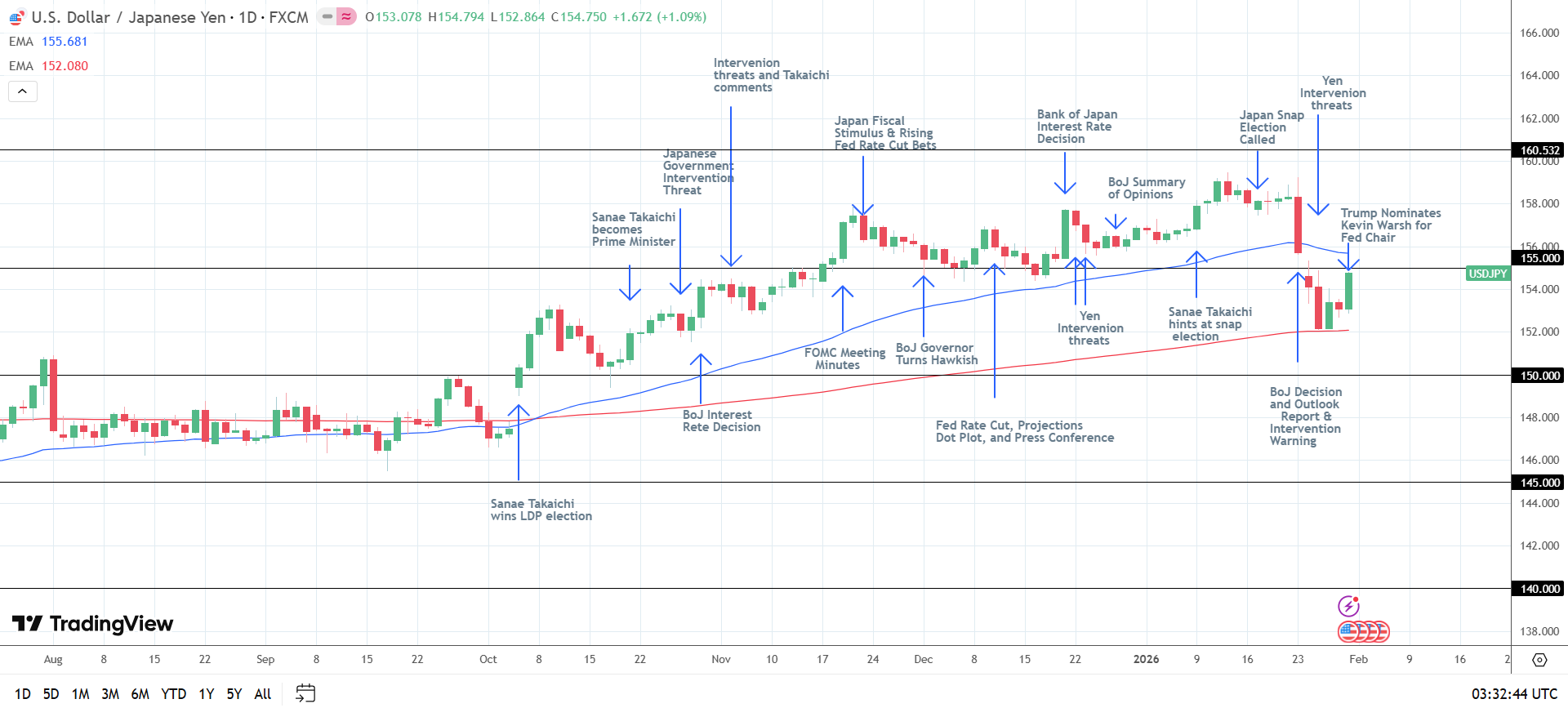
On the daily chart, USD/JPY traded below its 50-day Exponential Moving Average (EMA), but remained above the 200-day EMA. The EMA positions indicated a bearish near-term, but bullish longer-term bias. Developing positive yen fundamentals aligned with the bearish near-term technical, supporting the negative outlook for USD/JPY.
A break below the 200-day EMA would reaffirm the bearish trend reversal and expose the 150 support level. If breached, the 145-140 range would be the next key support range, aligning with the medium- to longer-term price projections.
Key Takeaways
The USD/JPY pair fell 1.34% in January, reversing the previous month’s 0.46% gain. A hawkish BoJ policy would signal a narrower rate differential, reinforcing the bearish short- to medium-term outlook for USD/JPY.
Risks of a yen carry trade unwind, and the potential for further policy divergence set up a bearish outlook.
Key levels will include 150 and 140 on the downside, and 155 and 160 on the upside.
Consult our economic calendar for historical and upcoming data.